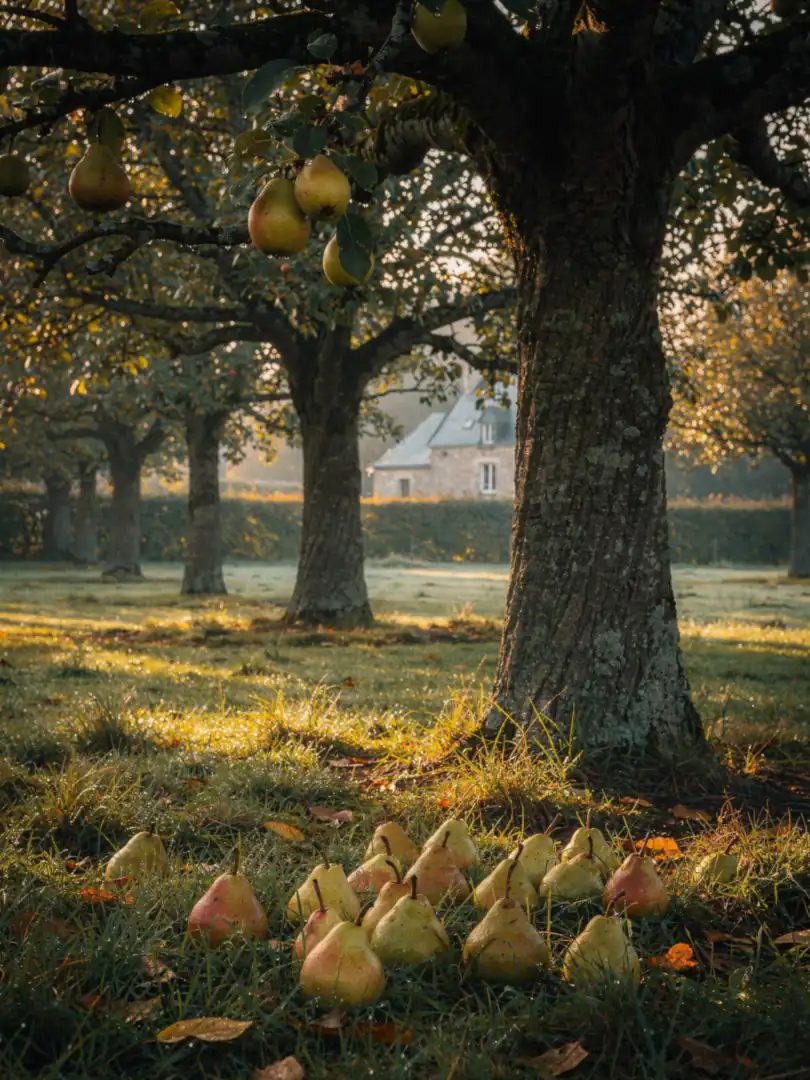
Perry Pears, Standard Trees
Fruit & Raw Material
A perry pear is not one you'd want to bite into: it's small, hard, and so full of tannins that it puckers the mouth. That's exactly what makes it valuable for poiré and for distillation. The tannins give the juice structure, and the small fruits carry more aroma than their looks suggest.
Around thirty varieties go into poiré, with names like Plant de Blanc, Rouge Vigné, Gros Blot, Plant Roux, De Cloche, and Gaubert. Plant de Blanc is considered the key variety, as it balances sweetness, acidity, and a touch of bitterness. Under the rules for Poiré Domfront, it must make up at least 40 percent of the blend, with no other variety exceeding 25 percent.
The trees are tall standards with wide-spreading crowns, often with livestock still grazing beneath them. They bear fruit only after many years, but live for centuries. This slowness shapes the farms of the Bocage: whoever plants an orchard today is harvesting mainly for the next generation.
Harvest comes late. Depending on the variety, the pears ripen from September into December, as described by the Lemorton estate, which grows more than forty apple and pear varieties on nine hectares. Many fruits fall ripe from the trees and are gathered from the ground rather than picked.
Apples and pears thus ripen over several months, giving the distiller a long window of raw material to work with. The mandatory pear content of at least 30 percent ensures that the pear remains tasteable in the glass and doesn't disappear behind the apple. Without the old standard-tree orchards of the Domfrontais, this spirit wouldn't exist in its current form.