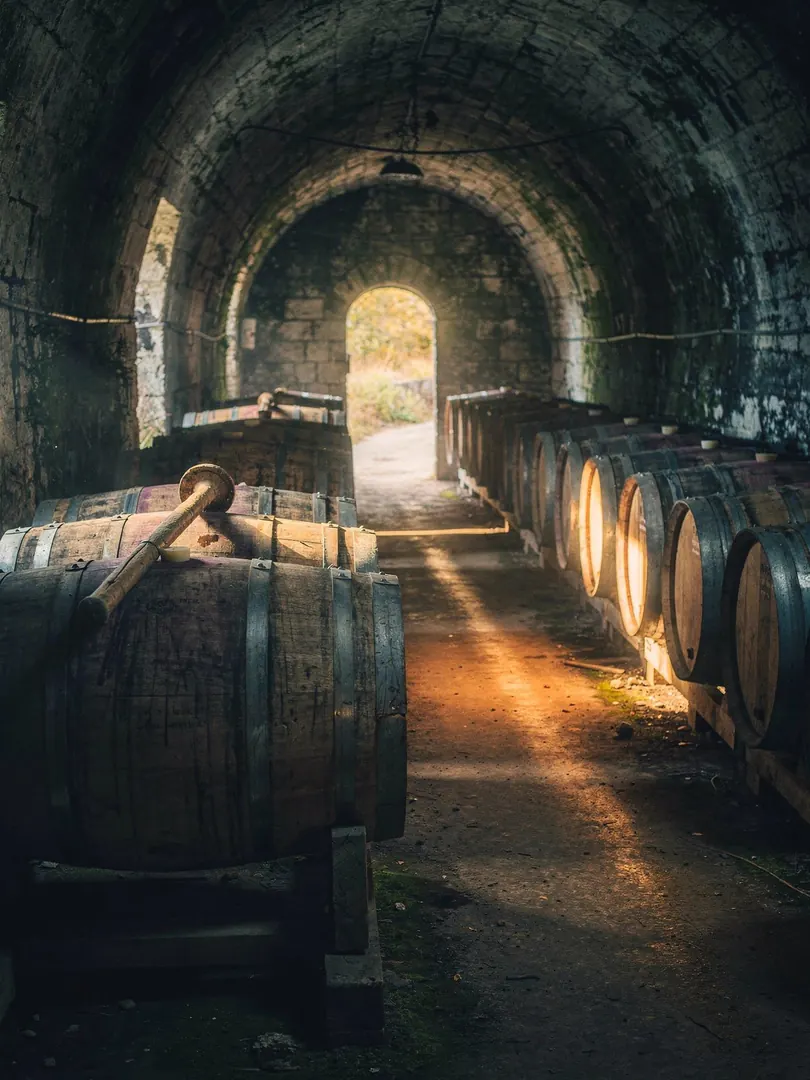
Three Years in Oak
Aging & Maturation
Three years in oak barrels is the minimum for Calvados Domfrontais, while standard Calvados requires only two. The fresh distillate comes out of the column colorless and sharp; only the wood turns it into a golden-brown spirit. Each year, part of it evaporates through the barrel staves — the so-called angels' share.
In the barrel, the spirit absorbs vanilla, spice, and tannins, and the oxygen that passes through the wood softens its sharpness. The pear remains recognizable but shifts from fresh fruit notes toward compote and dried fruit. The longer the aging, the quieter the fruit becomes and the louder the oak.
The label carries classifications like VSOP or XO. These refer to the youngest component in the blend, as spirits law requires for any age statement. A spirit sold under a given classification thus contains no Calvados younger than stated, though it often includes older barrels that round it out.
There are also vintage bottlings, where the spirit comes from a single harvest. The Lemorton estate is known for these: spirits from this house dating to 1971, 1972, 1999, and 2000 appear on the market. Such bottles show just how far a Domfrontais can travel through time.
Blending is the second art. The cellar master mixes barrels of different ages until the house hits its signature style. Drouin's Domfrontais, for example, is, according to the house, a blend of spirits aged between three and five years in small oak barrels.
Producers may only intervene within narrow limits. Caramel coloring or an infusion of oak chips may alter the spirit by no more than four percent by volume, as set out in the specifications. The spirit must be at least 40 percent alcohol by volume at bottling.