Beignets, Tarte, Festivals
Food & Tradition
On the third Sunday of September, Fougerolles-Saint-Valbert celebrates the Foire aux beignets de cerises, the Cherry Fritter Fair. A brotherhood of kirsch tasters parades through town in traditional dress, and new members are inducted at Château Bresson. The beignets themselves are cherries baked in batter, a pastry as much a part of the town's identity as the brandy itself.
Kirsch also finds its way into the kitchen. The Route des Chalots leads to distillers, restaurants and farm shops offering chocolate, cream, pastries, sausage, jam and ice cream flavored with kirsch. A chalot is a small wooden storehouse, an oak frame with fir planking and a roof of sandstone slabs. Around 320 of them stand between Lorraine and the Franche-Comté, 132 in Fougerolles alone.
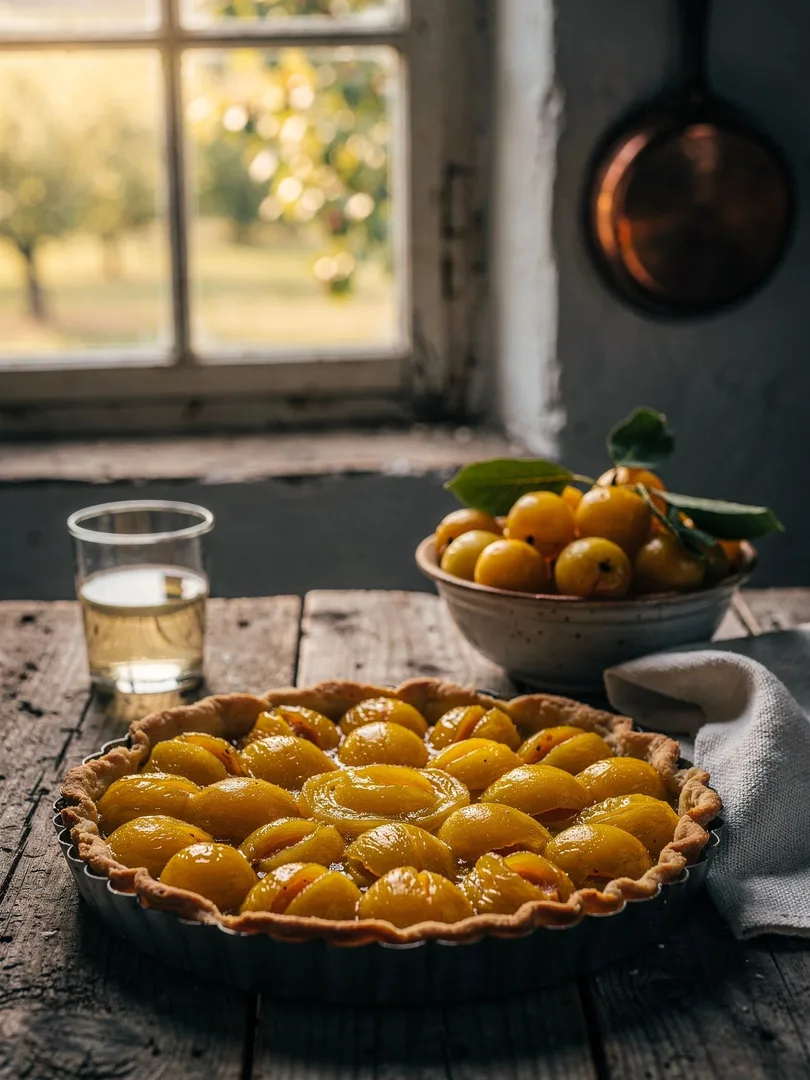
In Lorraine, late summer calls for tarte aux mirabelles on the table: a shortcrust base topped with halved yellow mirabelles that soften and release their juice as they bake. Anyone who already knows the fruit as a brandy will recognize its aroma at once.
Alsace celebrates too. In Westhoffen, cherries and kirsch are the occasion for their own festival, as noted on the heritage inventory map. Fougerolles calls itself the "Cité du Kirsch," and it's more than a marketing name: farmers, distillers, coppersmiths, coopers and basket weavers there have all made their living from the same fruit.
With Kirsch de Fougerolles, two roles are kept distinct in the kitchen: the rougher brandy goes to the pastry chefs, flavoring dough and creams. The fruitier one is served as a digestif at the table. So the same fruit ends up both in the household kitchen and in the glass beside it.
Where a small glass of mirabelle or quetsch appears at the end of a festive meal, it marks the close of the evening, not a thirst to quench. It fits, then, that cake and brandy are paired from the same fruit: the tarte carries the fruit, the glass carries its aroma.