Seven Protected Names
Region & History
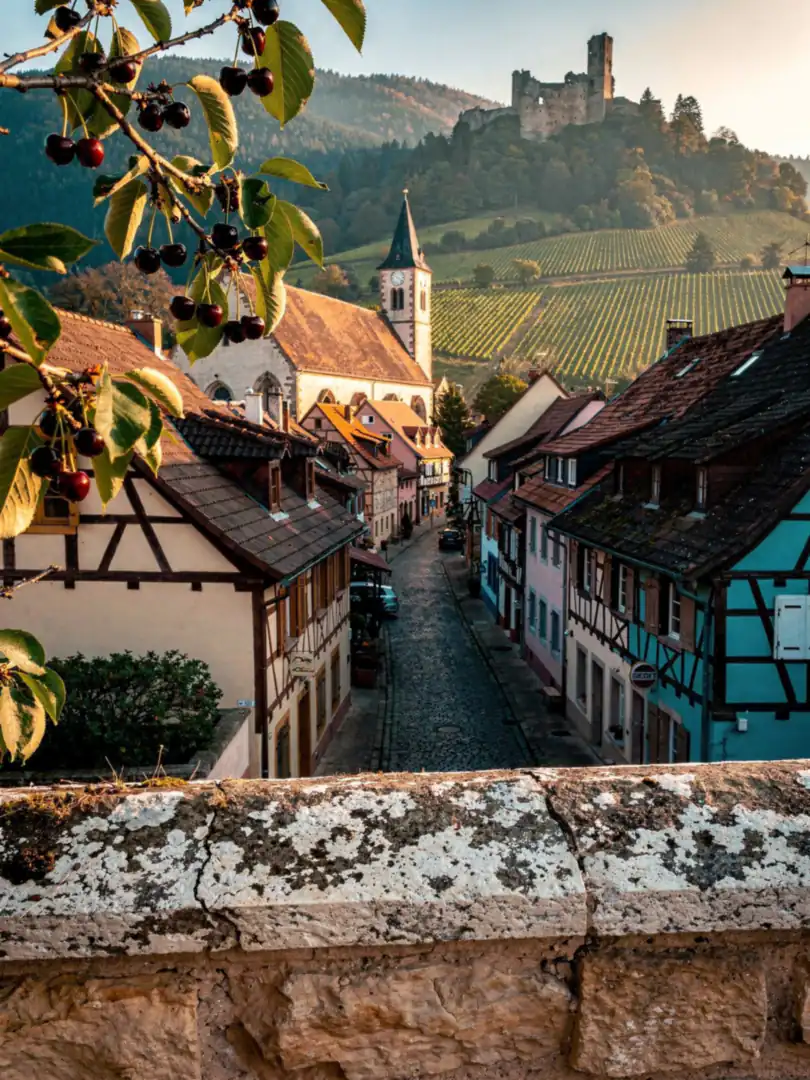
Where does kirsch come from, the Black Forest or Alsace? There's no single inventor. Cherry brandies emerged over centuries across the entire Upper Rhine region, in the valleys of the Vosges and on the hills beyond, wherever farmers had more cherries than they could eat or sell.
The best-documented history is that of Fougerolles in the Haute-Saône, at the foot of the Vosges. According to the inventory map of France's Ministry of Culture for intangible heritage, the fermenting and distilling of cherries began there in the 17th century. Since the end of the 18th century, Fougerolles has been known as the land of kirsch, and tradition has it that every newlywed couple was given a cherry tree.
France long recognized the farm distiller as a status of its own: under a 1923 law, the bouilleurs de cru, distillers working from their own harvest, were allowed to produce ten liters of pure alcohol tax-free. This privilege was gradually phased out; the 2008 budget law pushed its final abolition to the end of 2012.
Today the EU protects seven names from this area, all entered into the register on 12 June 1989: Kirsch d'Alsace, Framboise d'Alsace, Mirabelle d'Alsace, Quetsch d'Alsace, Marc d'Alsace Gewurztraminer, Mirabelle de Lorraine and Kirsch de Fougerolles. That date marks the registration; the distilling tradition itself is far older. For Mirabelle de Lorraine and Kirsch de Fougerolles, harvesting, fermentation, distillation and maturation must all take place within the defined area.
Two houses are known well beyond the region: Distillerie Miclo in Lapoutroie, founded by Gilbert Miclo in 1962, and Distillerie Metté in Ribeauvillé, where Jean-Paul Metté acquired his own pot still in the 1960s and bought fruit from local farmers.