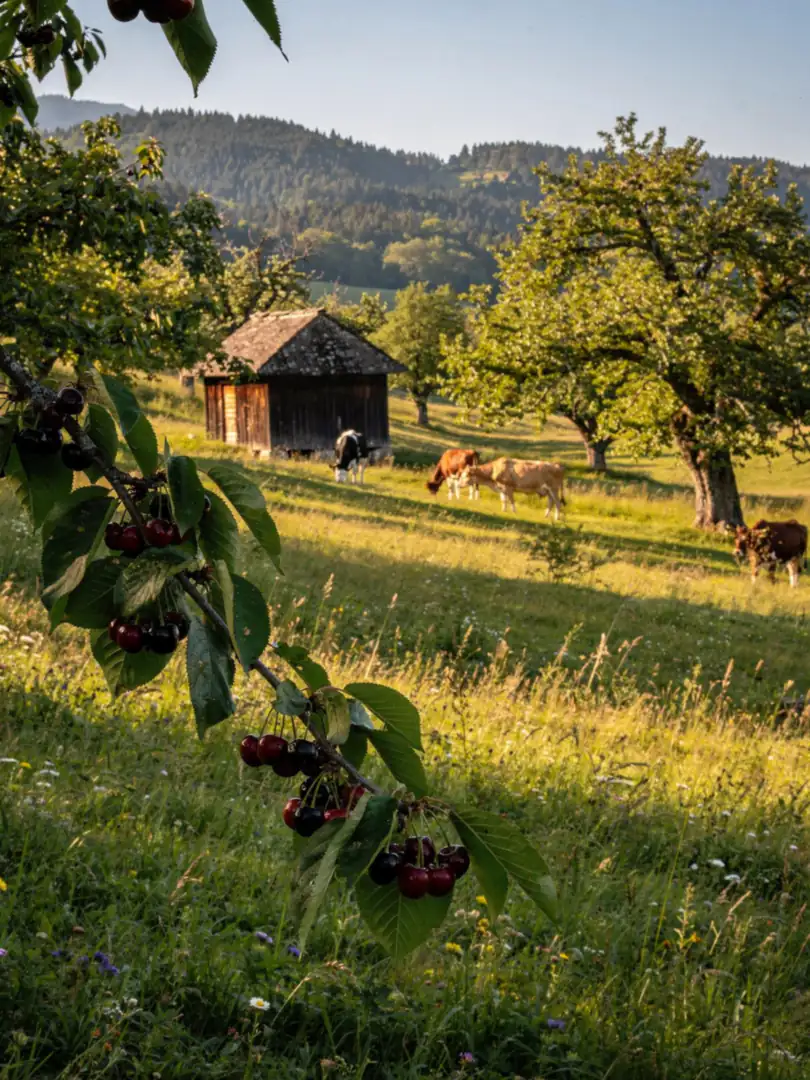
Pré-Vergers Full of Cherries
Fruit & Raw Material
The cherry harvest begins in Fougerolles in June and lasts only a few weeks into July. About 80 percent of the fruit now falls by itself: a large clamp on the trunk shakes the tree, and the cherries land on a catching cloth. Where picking is still done by hand, pickers climb the pied de chèvre, a three-legged wooden ladder that can reach up to twelve meters.
Two varieties go into the still: guignes and merises, both sweet cherries of the species Prunus avium. The guigne has soft, tender flesh. The merise is small, dark red to black, firm-fleshed, and its stone is hard to remove. Around forty local varieties are recorded in Fougerolles, including Béchat, Jean Blanc and Chapendu. Traditionally, a blend of many varieties goes into the still.
The trees stand in the pré-verger, an orchard meadow where cattle graze. The cows fertilize the soil, the trees provide shade, and the specifications require at least five different varieties per hectare. About 15,000 cherry trees stand in the area today, down from 35,000 in the 1950s. They yield around 500 tons of cherries a year.
From grafting to the first proper harvest takes about fifteen years. Anyone who plants is planting for the next generation.
In Alsace, guignes and merises are likewise permitted for Kirsch d'Alsace. The specifications call for fresh, sound, whole fruit at good ripeness from within the region; variety, soundness and ripeness are meant to deliver a mash with very high aromatic potential.
Lorraine, by contrast, is mirabelle country, home to the small yellow plum. The area for Mirabelle de Lorraine spans 1,275 communes across Meurthe-et-Moselle, Meuse, Moselle and the Vosges. "Quetsch" is the Alsatian name for the damson plum.