The Copper Still
Distillation
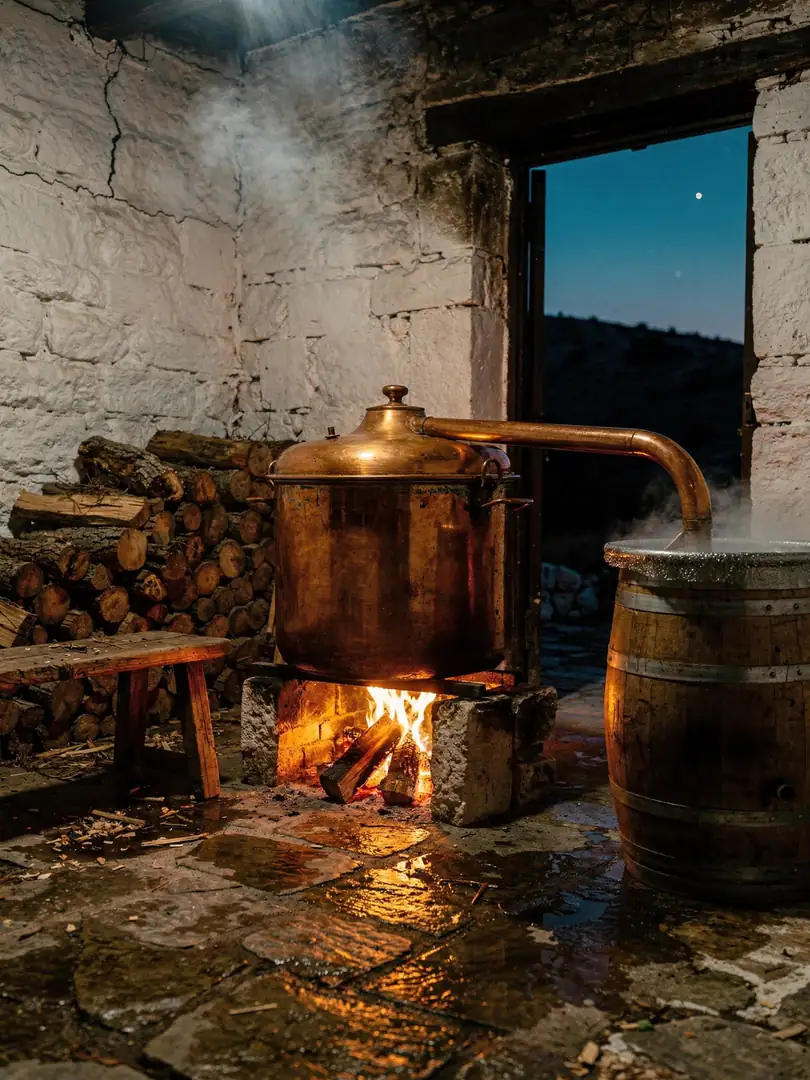
Tsikoudia is distilled in the Kazani, a copper still also called Rakokazano on Crete. The fermented pomace goes straight into the still, a tight-fitting lid sits on top, and a long pipe carries the hot vapor into a barrel of cold water, where it condenses into drops.
Traditionally, the still is heated with a wood fire. Villagers commonly report that the bottom of the still is often lined with olive wood branches to keep the pomace from scorching. If something burns, the brandy tastes bitter and smoky, and the batch is ruined.
EU law requires that pomace brandy's first distillation takes place in the presence of the pomace itself, and that every distillation stays below 86 percent alcohol. That's exactly what the Kazani delivers, never separating the pomace from the vapor.
As with any distillation, the distiller divides the run into three parts. The heads smell sharply of solvent, the heart carries the aroma, and the tails turn fusel and musty, likewise cut away. Methanol comes from the pectin in the skins and forms already during fermentation, not only during distillation. That's why the EU sets a maximum of 1,000 grams per hectoliter of pure alcohol for pomace brandy. Cutting the heads only partially reduces the methanol content.
The main distilling season runs from late October to early November, over two to three weeks. Operating a Kazani requires a permit. This isn't a step to take at home, and in Germany it's forbidden without a license.