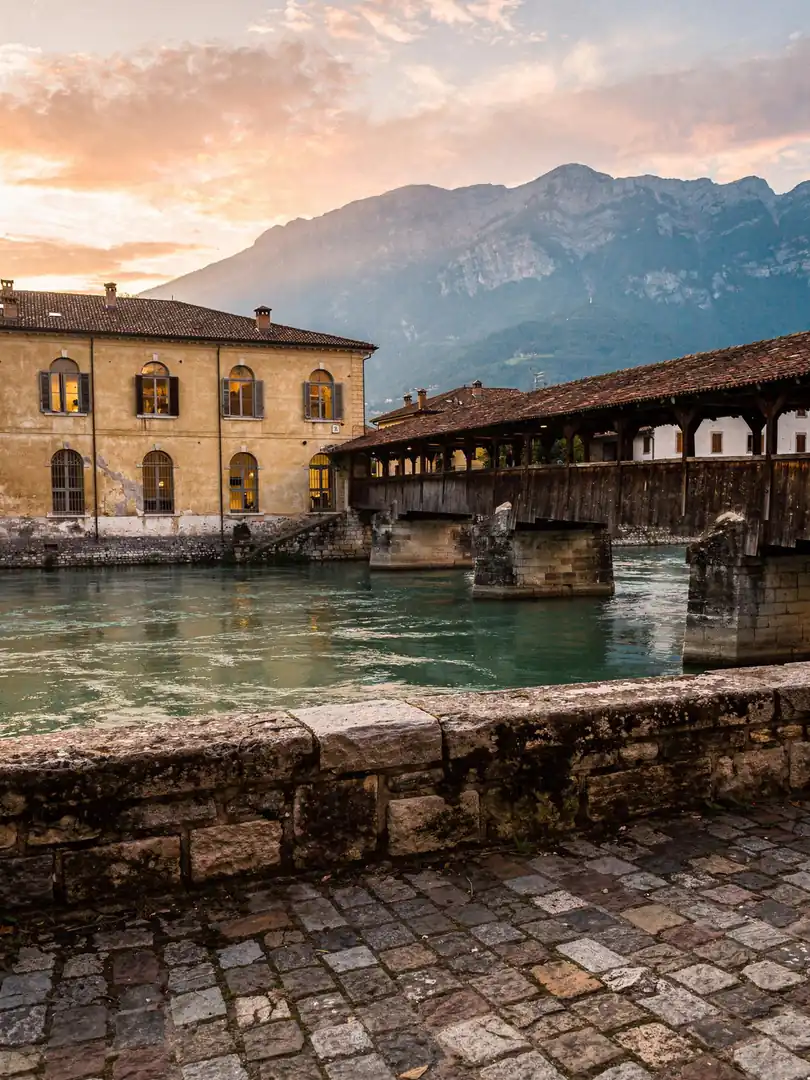
Brenta and Bridge
Region & History
Anyone wanting to know where the name Grappa comes from quickly ends up at Monte Grappa, the mountain north of Bassano. This derivation isn't actually documented—it's considered folk etymology: a name that sounds good and so gets passed along. More often, the word is linked to grappolo, the grape cluster. The town itself was called Bassano Veneto until the 20th century.
At the bridgehead over the Brenta, Bortolo Nardini bought an inn in 1779. According to tradition, the family came from Trentino and had previously traveled from place to place as itinerant distillers with a still. The Nardini distillery is considered the oldest Grappa distillery in Italy and still stands today at the foot of the wooden bridge known as the Ponte degli Alpini.
The covered bridge is based on a design by Andrea Palladio from 1569. Destroyed in the Second World War, it was rebuilt in 1947 and 1948 by Alpini mountain troops according to the old plans—hence its present name. The river supplied the distillers with water and led toward Venice.
A second strand of the story begins at Schiavon, southwest of Bassano. There, Giobatta Poli bought his first three copper stills in 1898, having previously run a tavern. According to the house, the business is now led by the fourth generation, and in Bassano a Grappa museum run by the family tells the story of distilling.
Legally, the name Grappa is reserved for Italy within the EU, and names such as Grappa del Ticino are also protected under an agreement with Switzerland. Grappa veneta or Grappa del Veneto is its own protected designation for pomace made from Veneto grapes and distilled in Veneto. There is no protected Grappa di Bassano: Bassano stands for a distilling tradition, not an appellation rule.