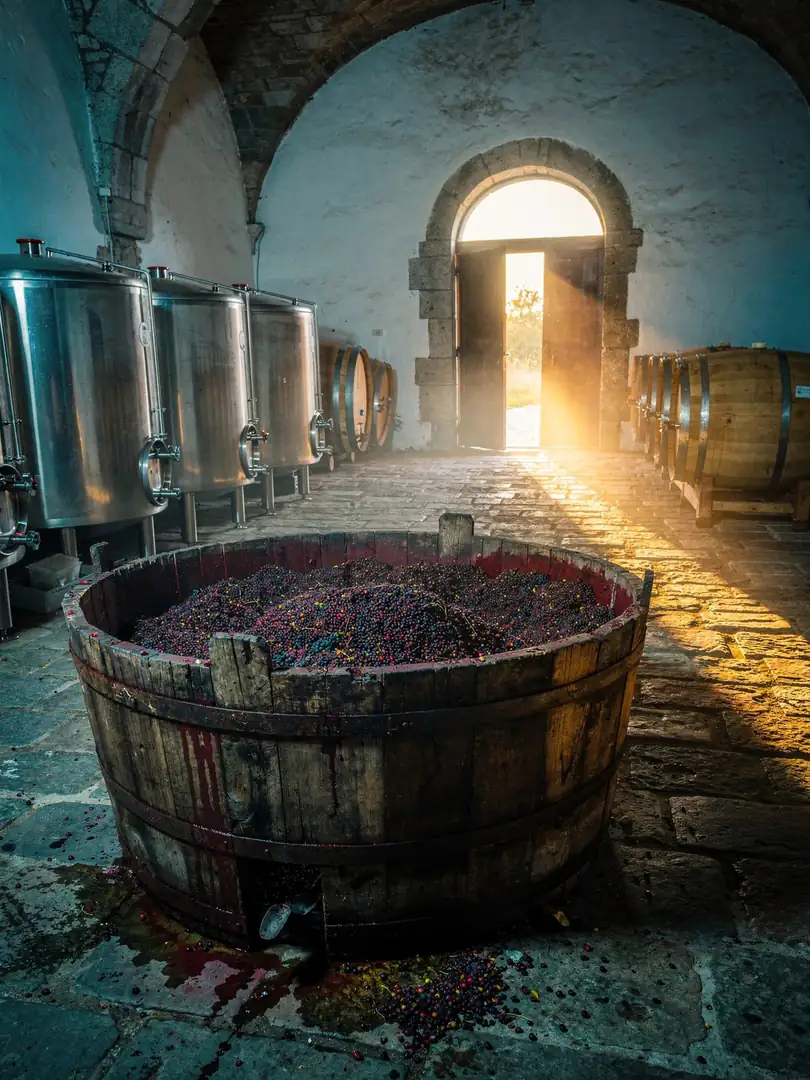
Fermenting Pomace
Mash & Fermentation
The raw material for Grappa has little to do with a mash in the usual sense. There's no fruit pulp that gets mashed first, but solid, moist pomace that still carries sugar and yeast on its skins. What's called fermentation in a cask for fruit brandy happens here in large, covered vessels or silos.
With red wine pomace, most of the work is already done, since fermentation took place back in the wine cellar. White wine pomace, such as that from Glera, is instead stacked, compacted, and sealed airtight. Under this seal, yeasts convert the residual sugar into alcohol, while oxygen would only produce acetic acid.
How long this takes depends on temperature and sugar content, and is measured in days to weeks. Cool storage preserves the fine aromas in the pomace. Distillers repeatedly check it by smell and condition, sorting out anything with mold or acetic notes. After that, it can wait as long as no air gets in.
The law sets limits here. Yeast lees may be added to the pomace, but no more than 25 kilograms per 100 kilograms of pomace, and the alcohol from the lees may not exceed 35 percent of the total alcohol. This keeps the spirit a true pomace brandy rather than turning it into a lees brandy.
Methanol also forms at this stage, arising from the pectin in the skins rather than during distillation itself. Every Grappa therefore contains traces of it, and the law sets an upper limit of 1,000 grams per hectoliter of pure alcohol for pomace brandy. In Bassano del Grappa, distilleries such as Nardini and Poli operate under state supervision.