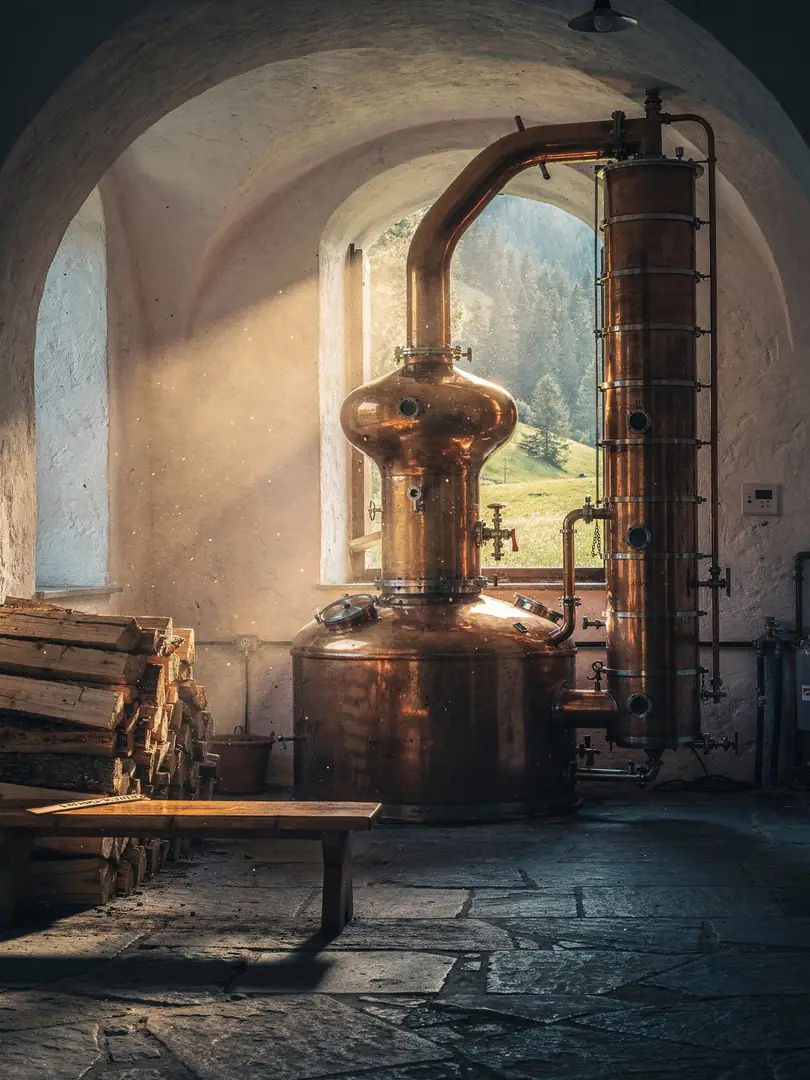
Bain-Marie and Copper
Distilling
Grappa is distilled differently from a fruit brandy: the pomace itself stays in the still, since the EU regulation requires the first distillation to take place in the presence of the pomace, either with direct steam or after adding water.
In Trentino, this takes two forms. Marzadro began in 1949 with a small, directly fired copper pot still, where the flame heats the kettle directly. Pisoni, by its own account, has used the bain-marie method — bagnomaria in Italian — for more than fifty years, following a process developed by Tullio Zadra. Here the still sits in hot water, and the pomace is gently warmed rather than scorched against hot metal.
Whether made from pomace or fruit, the distillate separates into three parts during distillation. First comes the heads, which smell of solvent and are cut away. Then follows the heart, the part destined for the bottle, and finally the tails, containing heavy, oily compounds that some distillers redistill. The heart often makes up only a portion of the total volume.
The heads cut isn't a cure-all against methanol. The compound comes from the fruit's pectin and already forms in the mash; that's why the EU sets maximum limits — for pomace brandy, 1,000 grams per hectoliter of pure alcohol. Even a cleanly separated heads cut only removes part of it. The same rule applies to Grappa trentina and Williams trentino: each distillation may reach a maximum of 86 percent alcohol, beyond which the aroma of the raw material would be lost.
Genziana trentina, as its specification requires, is both distilled and bottled in Trentino; with this spirit, everything from raw material to bottle stays within the province.
This isn't something to try at home: in Germany, distilling without a license is illegal, and it takes considerable experience to safely tell heads, heart, and tails apart.