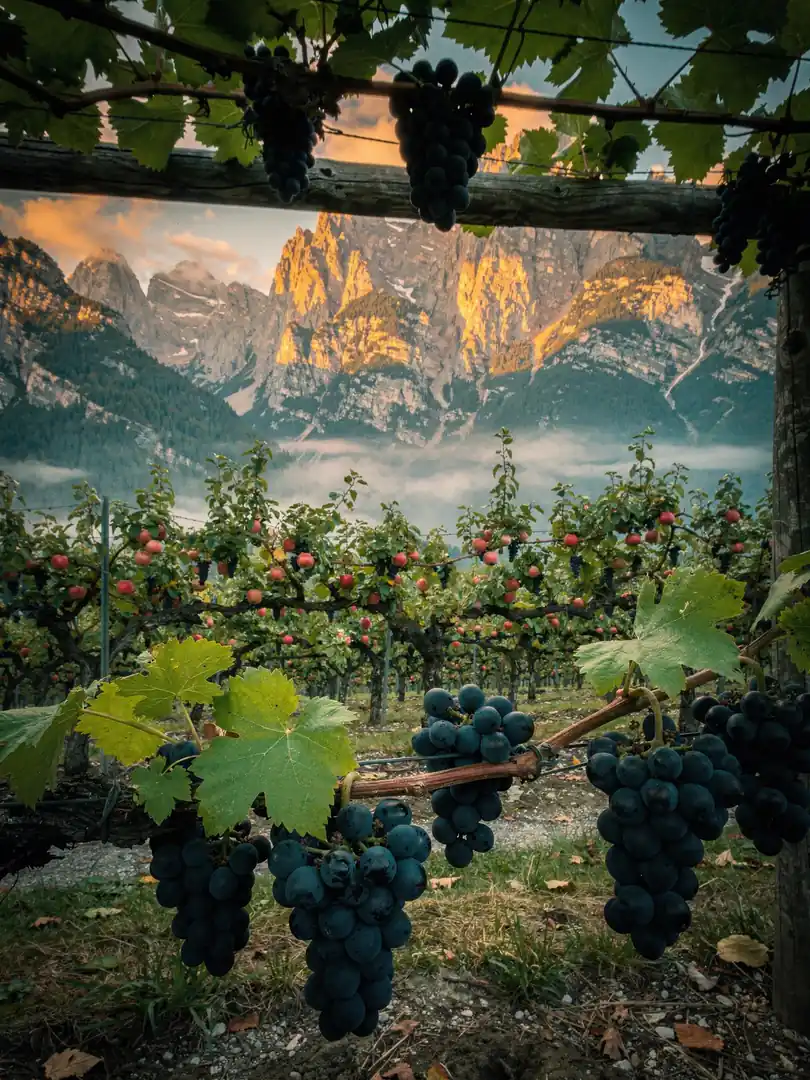
Teroldego and Apples
Fruit & Raw Material
What grapes does Grappa trentina come from? None in particular, since the brandy is made from pomace — the skins, seeds, and stems left over in the cellar after the grape harvest. What makes it special are the varieties: in Trentino, the pomace often comes from native grapes such as the red Teroldego and the white Nosiola.
Teroldego grows mainly in the Piana Rotaliana near Mezzocorona and Mezzolombardo, while Marzemino is found further south around Isera in the Vallagarina. Because pomace spoils quickly, it moves swiftly from the press to the distillery.
With fruit, a second landscape comes into play: according to Trentino's tourism board, the Val di Non and Val di Sole are home to around 7,000 hectares of orchards, farmed by more than 4,000 growers. Apples are also the source of Distillato di mele trentino, which carries its own designation of origin.
Alongside these, cherries, apricots, plums, and Williams pears each have their own registered names: Kirsch Trentino, Aprikot trentino, Sliwovitz trentino, and Williams trentino. Behind each lies a fruit brandy made from fermented fruit — an eau-de-vie in the sense of the EU regulation, not a spirit made from macerated fruit.
A special case is Genziana trentina: instead of fruit, the root of the yellow gentian provides the raw material, and according to the specification, the roots must be grown and processed within the province of Trento. Fermented and distilled, they yield a bitter, earthy spirit.
Expertise in viticulture and fruit growing has a fixed home in Trentino: on 12 January 1874, the Tyrolean parliament in Innsbruck decided to establish an agricultural school with an experimental station in the former monastery of San Michele all'Adige. The Austrian Edmund Mach took charge of it, coming from the Institute of Oenology and Pomology in Klosterneuburg. Today the institution bears his name: Fondazione Edmund Mach.