Axberg and the Hausruck
Region & History
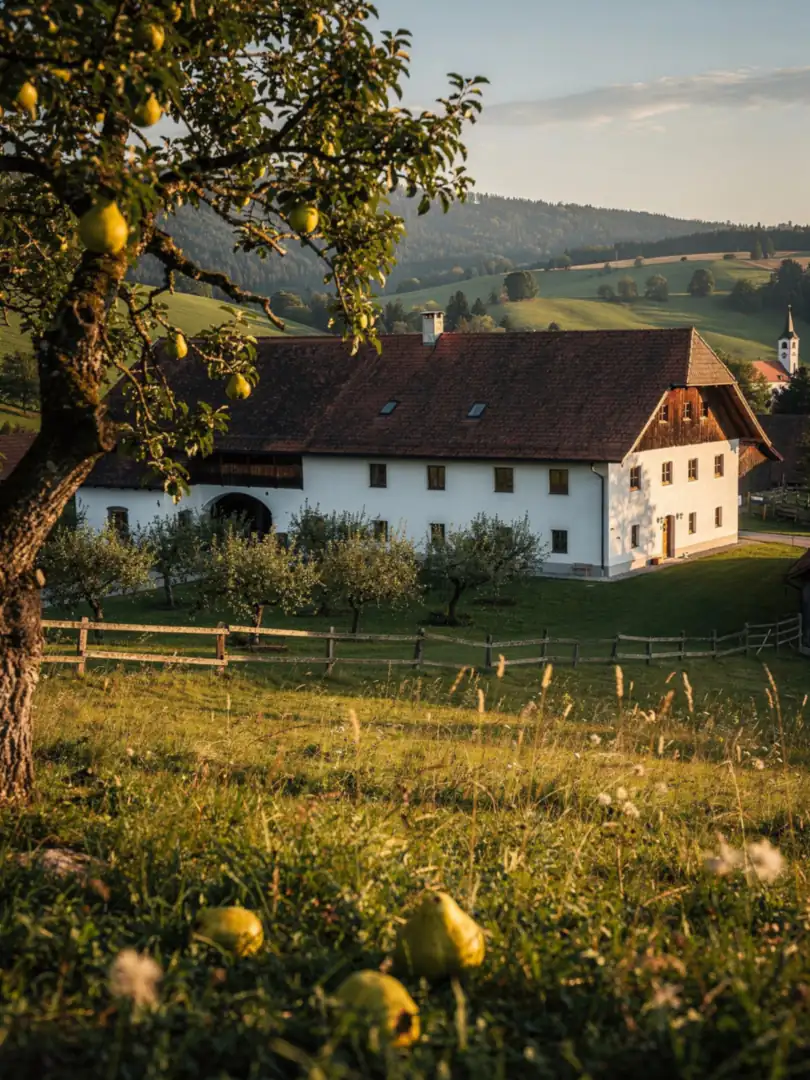
Anyone asking about fine fruit brandy in Upper Austria soon ends up at Reisetbauer in Axberg, a part of Kirchberg-Thening near Linz. According to the estate, Hans Reisetbauer planted the first orchard there in 1990. Four years later, in 1994, the first still went into operation, built to his own specifications by a plant engineer.
It began in 1995 with a small bottling of Williams pear brandy, by the estate's own account around a hundred bottles, which quickly sold out at top Viennese restaurants. In the mid-1990s a whisky was added, later a gin. To this day, the estate's reputation rests on its fruit brandies. According to the house, the family now farms around 140 hectares, managed organically.
The area also has its own fruit-growing tradition. In the Hausruckviertel, perry established itself around 1540 as a household drink for farmers and laborers, according to the Ministry of Agriculture. In 1789 Emperor Joseph II decreed that fruit trees be planted, and fruit growing had already expanded significantly under Maria Theresa. Since 2007 the regional association Mostlandl-Hausruck has brought this culture together.
Who is allowed to distill schnapps in Austria? Distilling must be registered with the customs office, and illicit home distilling remains banned. Farmers entitled to the flat-rate allowance may, according to the Upper Austrian Chamber of Agriculture, produce 100 liters of alcohol per calendar year at a reduced tax rate. Only a small amount of home distillate remains tax-free, up to 27 liters of alcohol for farming families.
There is no protected designation of origin for brandy in Upper Austria. Wachauer Marillenbrand and Osttiroler Pregler are listed in the EU register, but a brandy from the Hausruck or from Axberg is simply named after its fruit. Its reputation therefore rests on the producer, not on a geographical boundary.