Pear, Quince, Perry Pear
Fruit & Raw Material
What is a Williams pear, and why can only a brandy made from it be called Williams? The variety is soft, juicy and highly aromatic. Under EU spirits regulations, a pear brandy may only be labeled Williams if it is made exclusively from pears of this variety. A brandy made from mixed pears must simply be called pear brandy. Alongside its Williams, Reisetbauer also produces a brandy from the Red Williams pear.
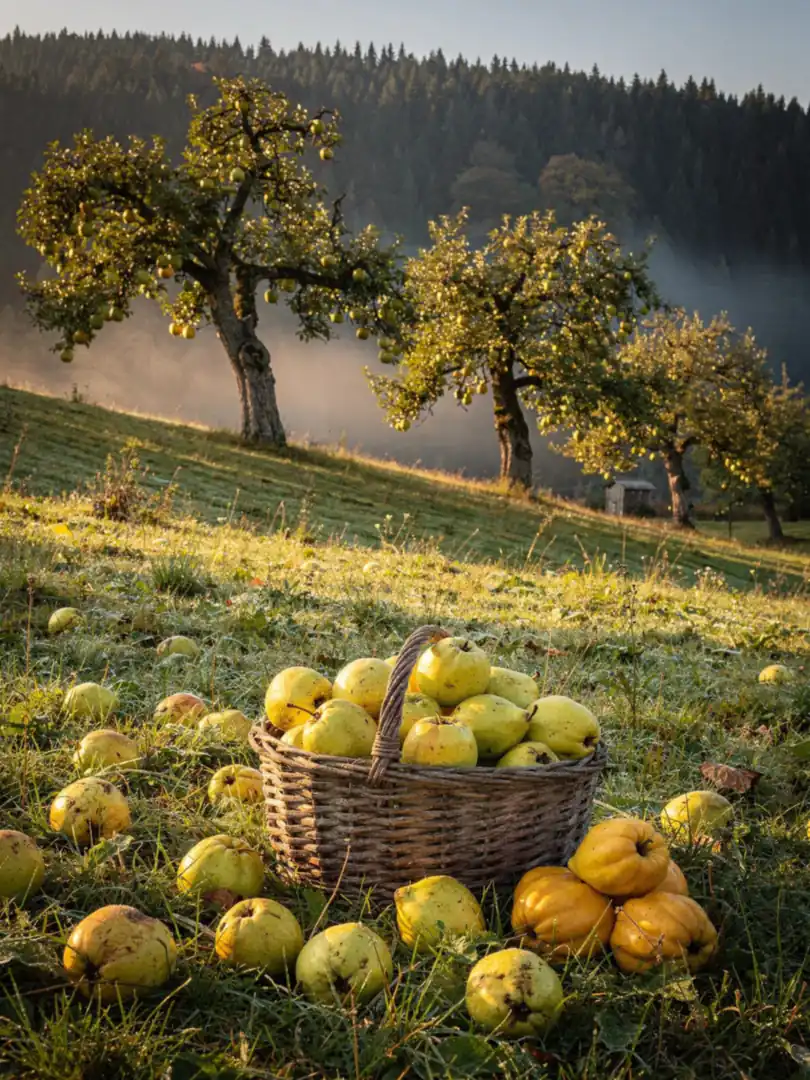
Besides pears, the estate processes quince, apples, raspberries and rowan berries, as well as carrots and ginger. The quince is hard, tart and barely edible raw. Only through distillation does it become a fragrant brandy. Under EU regulations, vegetables may be fermented and distilled like fruit, provided no added alcohol is used.
In the Hausruckviertel, by contrast, it is mainly perry pears that grow. The area lies between the Eferding Basin in the east and the Hausruck forest in the west. The Ministry of Agriculture names the Speckbirne as the main variety, alongside the Winawitzbirne, red and green Pichlbirne, Frauenbirne and Brünnerling. Between the Hausruck and the Traisen river in Lower Austria lies, according to the ministry, the home of many Austrian perry pear varieties.
For perry, windfall fruit is gathered from late September until the first frost. It comes from standard trees on traditional meadow orchards, which mostly grow without rows and with little pruning. How good the Hausruck pear-apple perry turns out, the ministry says, depends on the upkeep of the meadows, the right harvest time, and swift processing.
Anyone distilling fruit needs ripe fruit with plenty of sugar, since sugar is what later becomes alcohol. Unripe fruit yields little and tastes thin in the brandy. For a fruit grower, then, harvest time follows ripeness, not the calendar.