Fruit and Volcano
Region & History
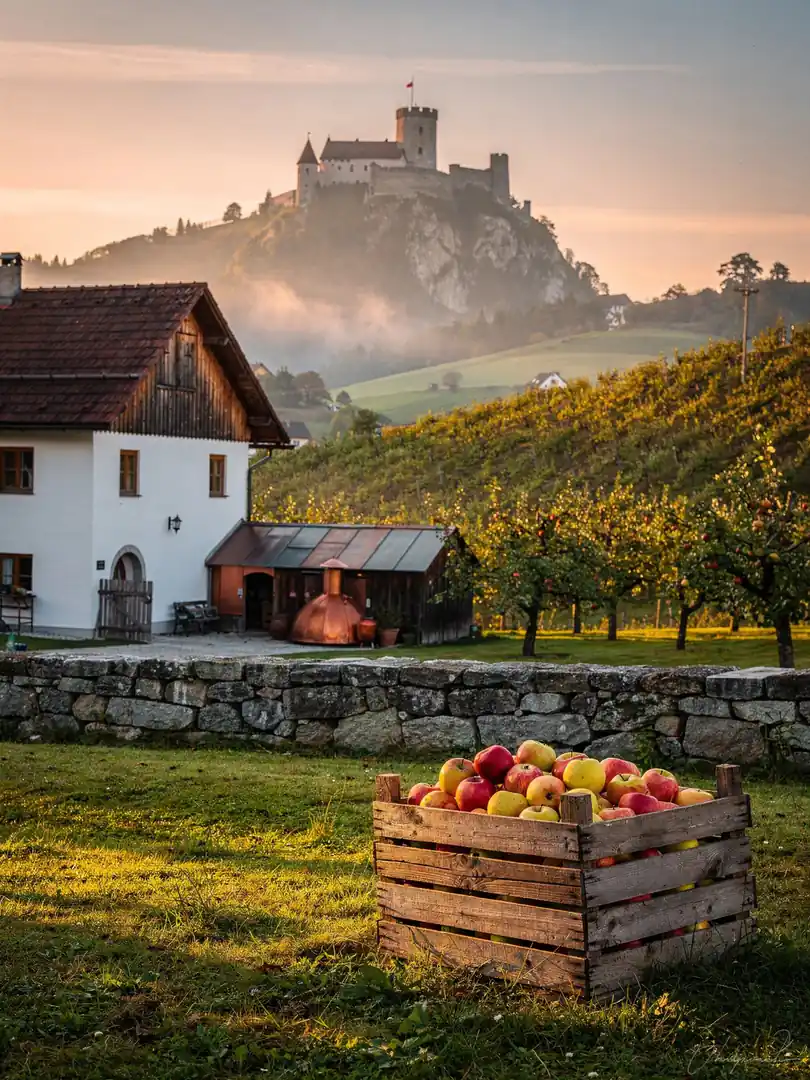
Riegersburg Castle rises above the Vulkanland on a rock of volcanic origin, and at its foot lies one of the centers of Styrian fruit brandy production. Apples, pears, and plums have belonged to the farms here for generations, and whatever the fresh market didn't need was turned into brandy.
No record survives of exactly when the first brandies were distilled on Styria's farms. The national Register of Traditional Foods traces the earliest references to alcohol production from Styrian Kriacherl back to the Middle Ages. For the Hirschbirne pear, the oldest written evidence comes from the village chronicle of Pöllau, written between 1894 and 1899.
In Austria, only those who register with the customs office may distill, and moonshining is forbidden. Farmers with a settlement right (Abfindungsrecht) produce their brandy at a reduced tax rate. The tax-free home distillation allowance is tightly limited: according to the Chamber of Agriculture, a farmer and spouse together may distill 15 liters of pure alcohol, with family members and employees allowed 3 liters each, for a total maximum of 27 liters.
One of the best-known houses is Gölles in Riegersburg, where the family has tended its orchards for four generations. According to the house, Alois Gölles Sr. laid the foundation in the late 1950s and was among the first farmers in southeastern Styria to plant apple trees. Alois Gölles, who grew up in this fruit-farming family, trained at the Klosterneuburg School of Viticulture and Fruit Growing, began refining fruit into spirits in 1979, and revived the farm's old distilling rights.
The Ministry of Agriculture lists four Styrian brandies in its register: Styrian Hirschbirne Pear Brandy, Styrian Maschanzker Apple Brandy, Styrian Kronprinz Rudolf Apple Brandy, and Styrian Kriacherl. The register documents origin and tradition but is not an EU seal. The distillery in Riegersburg also produces vinegar alongside its brandies.