Orchard Fruit and Root
Fruit & Raw Material
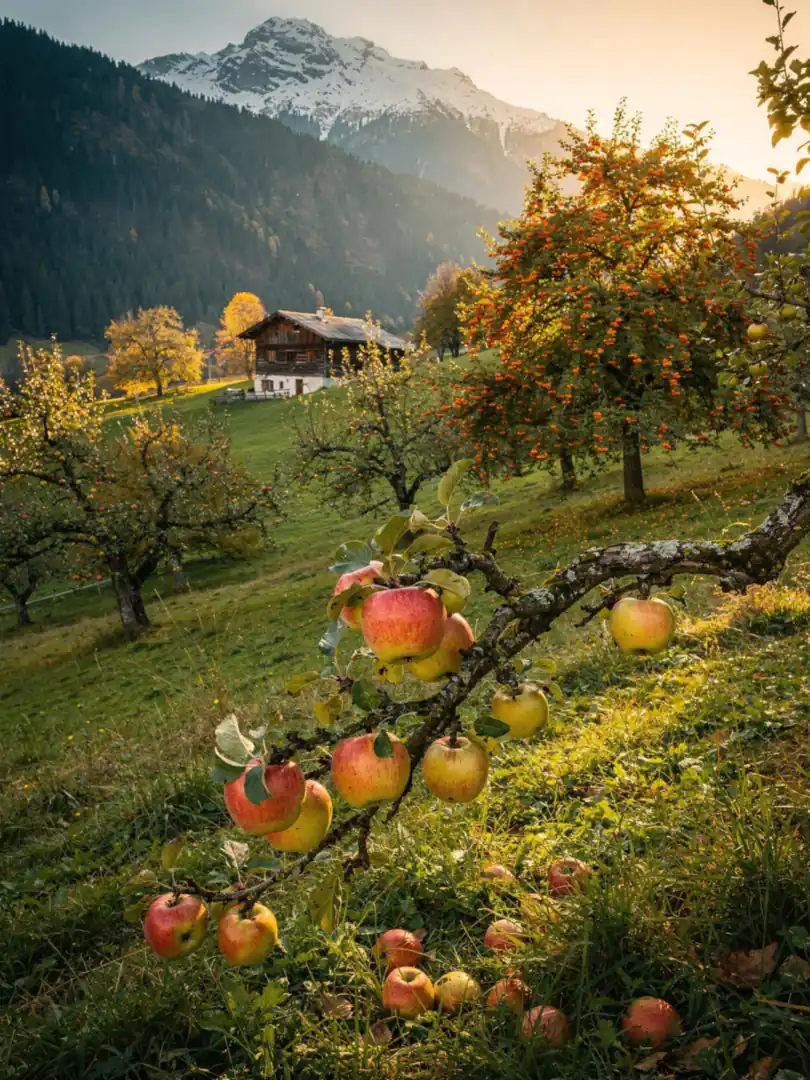
What is an Obstler? In an Obstler, at least 85 percent of the mash must come from apples and pears, with up to 15 percent allowed from other fruits or berries. In Tyrol, it's the everyday brandy. The fruit comes from commercial orchards, from the scattered orchard trees on the valley slopes, and from home gardens.
Things get stricter in the Lienz district. Osttiroler Pregler requires old East Tyrolean apple varieties and perry pears, with plums permitted only as an exception under the rules of the Austrian Food Codex Commission. Raw material, distilling, and production must all stay within the district, making it a brandy drawn from the orchard fruit of a single valley.
It gets wilder with the rowanberry. The rowan tree grows along roadsides and forest edges, and its brandy has a tradition in Tyrol, Styria, and Salzburg. The berries hang in clusters that the distiller must strip off by hand before the fruit goes into the mash. The yield of finished brandy is very low, which is why Vogelbeerbrand is considered a labor-intensive farmhouse spirit.
And then there are the roots. Enzianbrand comes from yellow gentian and spotted gentian. Meisterwurzbrand is made from the root of masterwort, which already appears as a medicinal plant in the writings of Hildegard von Bingen, mentioned between 1150 and 1160 under the name "Astrenica." It's distilled in the Zillertal and throughout North and East Tyrol, and it tastes fresh and spicy.
Most unusual of all is the stubble turnip. The white autumn turnip, botanically Brassica rapa, supplies the raw material for Wildschönauer Krautinger. No other region in Austria distills turnips, so there's no benchmark against which to measure this brandy.