Clay Instead of Oak
Aging & Storage
A wooden barrel never touches Pisco from Peru. The standard requires that the freshly distilled spirit rest for at least three months in neutral vessels, naming glass, stainless steel, and clay as options. Wood is expressly forbidden. The goal is a clear, colorless spirit that smells of grape rather than vanilla or toasted oak.
Why the pause? Straight after distillation, a spirit tastes raw and unsettled, and volatile compounds only dissipate gradually. After some weeks or months resting in a neutral vessel, the Pisco rounds out and becomes more harmonious. Beyond the minimum, each house decides for itself how long its spirit rests.
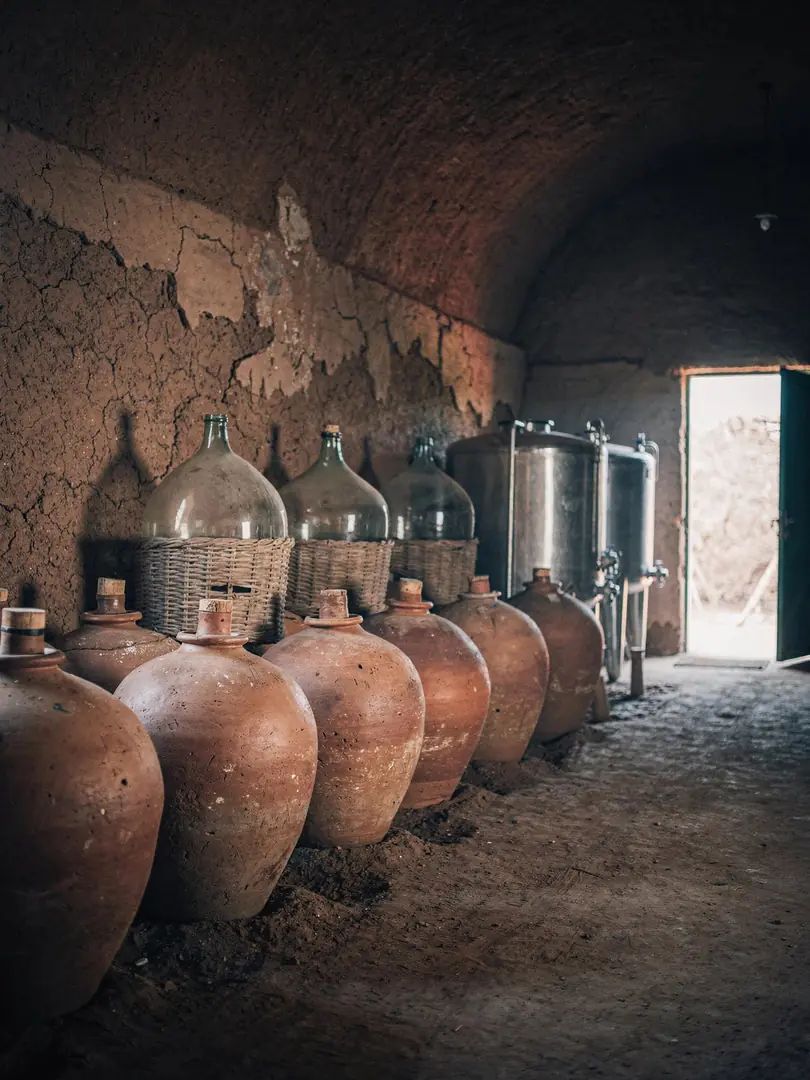
Closely tied to Ica and Lima are the Botijas, bulbous clay jars. Pisco was once stored and transported over long distances in these vessels. Clay neither absorbs flavor nor imparts any, which is exactly why it suits the standard's requirements. On some haciendas, rows of old Botijas still stand in the cellar today, alongside stainless steel tanks and large glass demijohns.
Pisco knows no age ladder like Cognac's VS, VSOP, and XO. Vintage years aren't read as a mark of quality here; instead, people look to the grape variety, the style, and the house. Resting time is simply a stage on the way to the finished spirit, not a selling point.
Neighboring Chile, by contrast, does allow Pisco to age in wood; the two countries take different paths here, and both are tradition in their respective homelands. Anyone curious how much a barrel can shape a spirit will find the counterpoint in whisky, whose aroma derives largely from the wood.