Rest in the Vessel
Maturation & Storage
Fresh from the still, every distillate is rough, and Medronho too needs time afterward to become round. However, the EU prescribes no minimum maturation period for fruit spirits, and unlike brandy, there is no requirement for oak. For a brandy from the Serra de Monchique, it is therefore mainly the work beforehand that defines the character, not the storage.
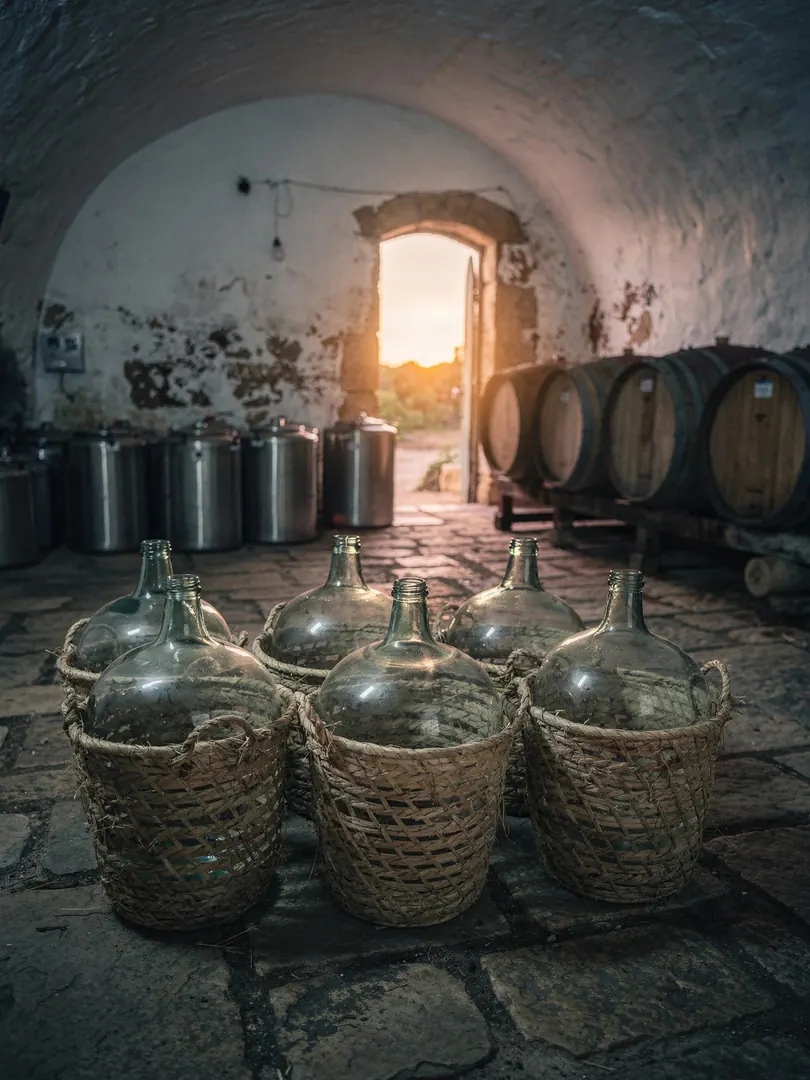
The brandy may therefore rest wherever the producer deems fit. Common for fruit spirits are neutral containers such as glass demijohns and stainless steel, and formerly also stoneware, because they don't alter the fruit aroma. The scent of berries is volatile, and neutral vessels preserve it just as it comes from the still. The result is a colorless, clear brandy, and this is how most people know Medronho.
Wood is not forbidden. Where it is used, it colors the brandy and gives it notes that have nothing to do with the fruit. Otherwise, a fruit spirit may not be colored. Caramel coloring, that is, sugar coloring, is only permitted if it has had at least one year of contact with wood.
Age categories such as VS or XO are not recognized under EU law for fruit spirits. If an age statement appears on a bottle, it is the producer's own claim and not a standard set by regulation. How long a brandy rests is decided by the producer.
Finally, the brandy is brought to drinking strength with water. It may hardly be sweetened at all: for fruit spirits, the limit is a maximum of 18 grams of sugar per liter. Medronho belongs to those spirits expected to be dry, without any sweetness.