Copper in the Mountain Village
Distillation
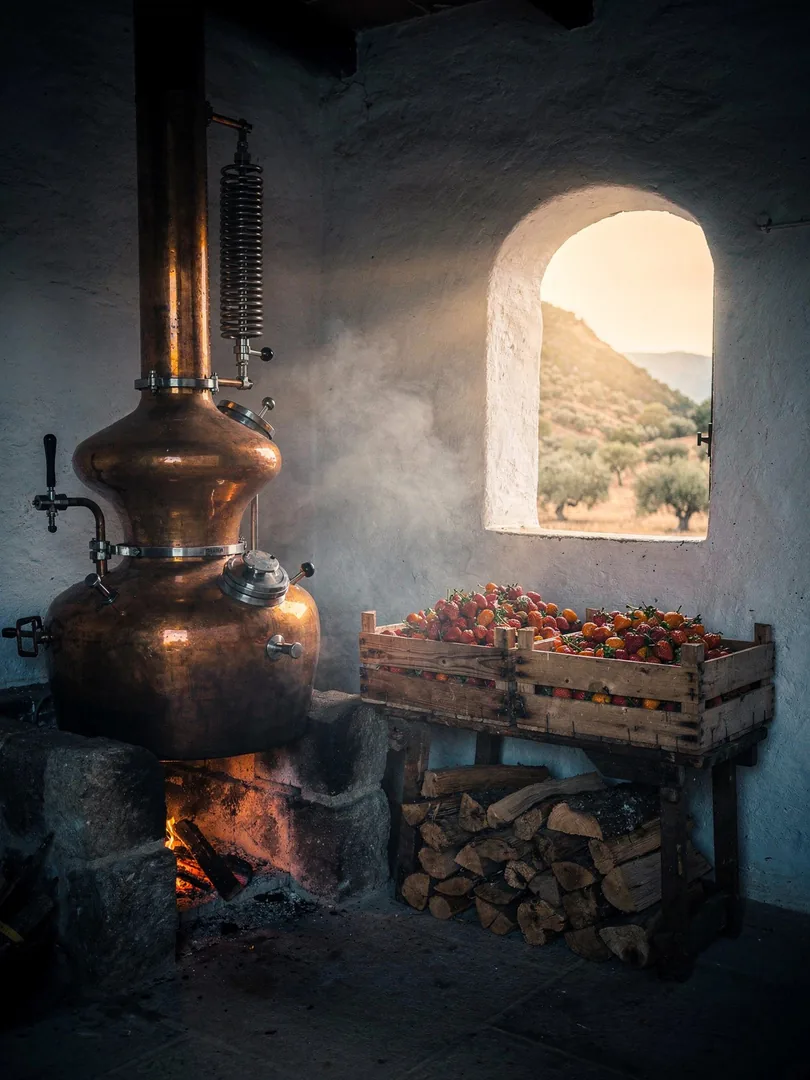
Distillation takes place in a still, the Alambique, which according to specialist literature should be made of copper or at least contain copper. Pipes and the cooling coil, however, are often made of stainless steel, since copper is difficult to keep clean under rural conditions.
What happens in the still can be explained simply. The mash is heated, the alcohol evaporates before the water does, the vapors rise, travel through the cooling coil and turn back into liquid there. The more evenly the heat is applied, the cleaner the work can be, though this is a matter of the distiller's experience. The result is a distillate rich in alcohol that carries the scent of the fruit.
The distiller divides it into three parts. First comes the head, which smells of solvent. Then follows the heart, the core, and finally the tail with heavy, fusel-like substances. Only the heart becomes the brandy.
Contrary to a common misconception, methanol is not created by distillation itself, and separating out the heads only removes it partially. Safety therefore depends on healthy, clean mash and on the legal maximum values.
The EU permits only distillates below 86% ABV for fruit spirits, so that the flavor of the fruit is preserved, and requires at least 37.5% ABV in the bottle. For Medronho, bottlings according to the literature are often around 48 to 50% ABV.
In Germany, distilling without a license is prohibited. Here the focus is on understanding, not imitation. The knowledge of heat and cuts lies with the distillers, who learn it over years.