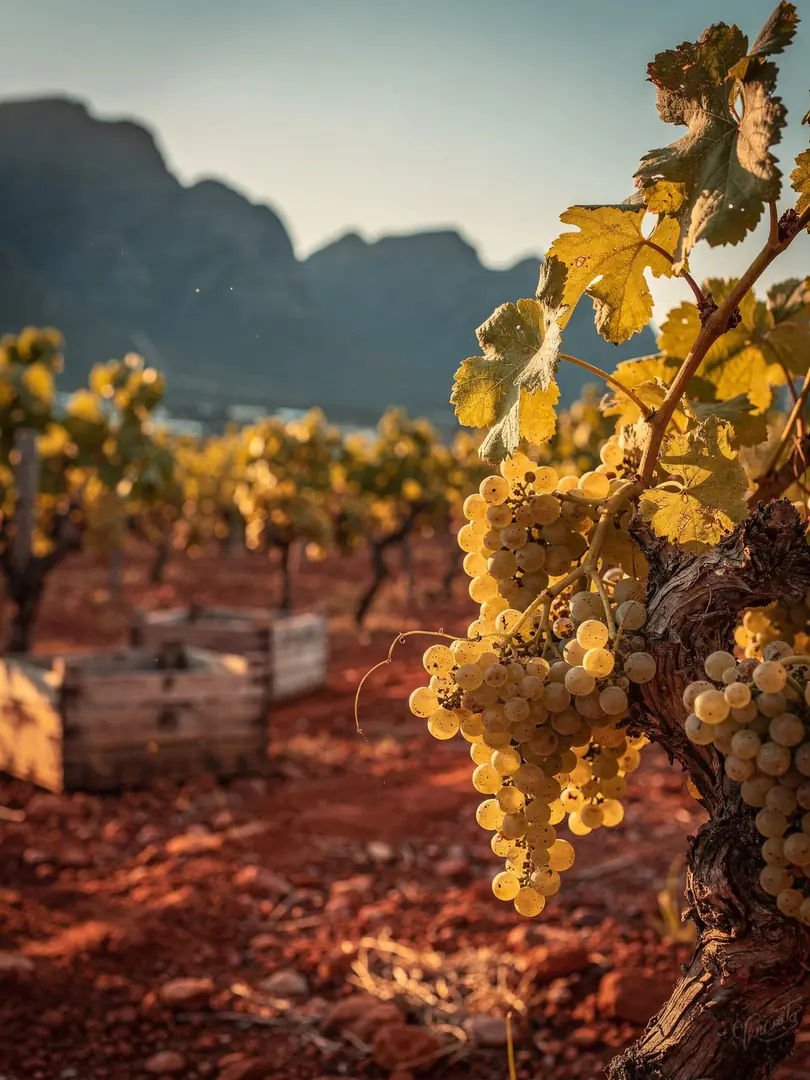
White, High-Acid Grapes
Fruit & Raw Material
Which grapes go into South African brandy? According to the South African Brandy Foundation, mainly Chenin Blanc and Colombar, two white varieties known for their high natural acidity.
At the Cape, Chenin Blanc has long gone by the name "Steen," and some of the vines growing there rank, by industry accounts, among the oldest in the world. Colombar is a high-yielding variety that produces a neutral, fresh wine that causes little trouble later in the still.
So why these particular grapes? A wine nobody would really want to drink with dinner often makes the best base for distilling: dry, acid-driven, and moderate in alcohol. Heating it releases clean, pure wine aromas, free of residual sugar or heavy notes that can't be separated out later. According to industry figures, it takes roughly five liters of this wine to produce one liter of brandy.
The grapes come from the wine regions around Paarl and Stellenbosch, from the Breede River Valley near Worcester and Robertson, and from the Little Karoo. Summers there are dry and warm, and harvest falls in the Southern Hemisphere summer, in the first months of the year.
The comparison with Cognac is an obvious one, since there too a high-acid white variety, Ugni Blanc, provides the base wine for distillation — low in alcohol and sharp, exactly what a distiller wants. In the Western Cape, the climate lends a hand: days turn hot, while at night sea breezes often cool the slopes, helping the grapes hold onto their acidity.
The grapes don't need to reach peak ripeness. Berries picked early carry more acid and less sugar, yielding a lean base wine that the still can later coax the best out of. What's wanted is a clean, lean wine in large volume — not a showpiece for the wine list.