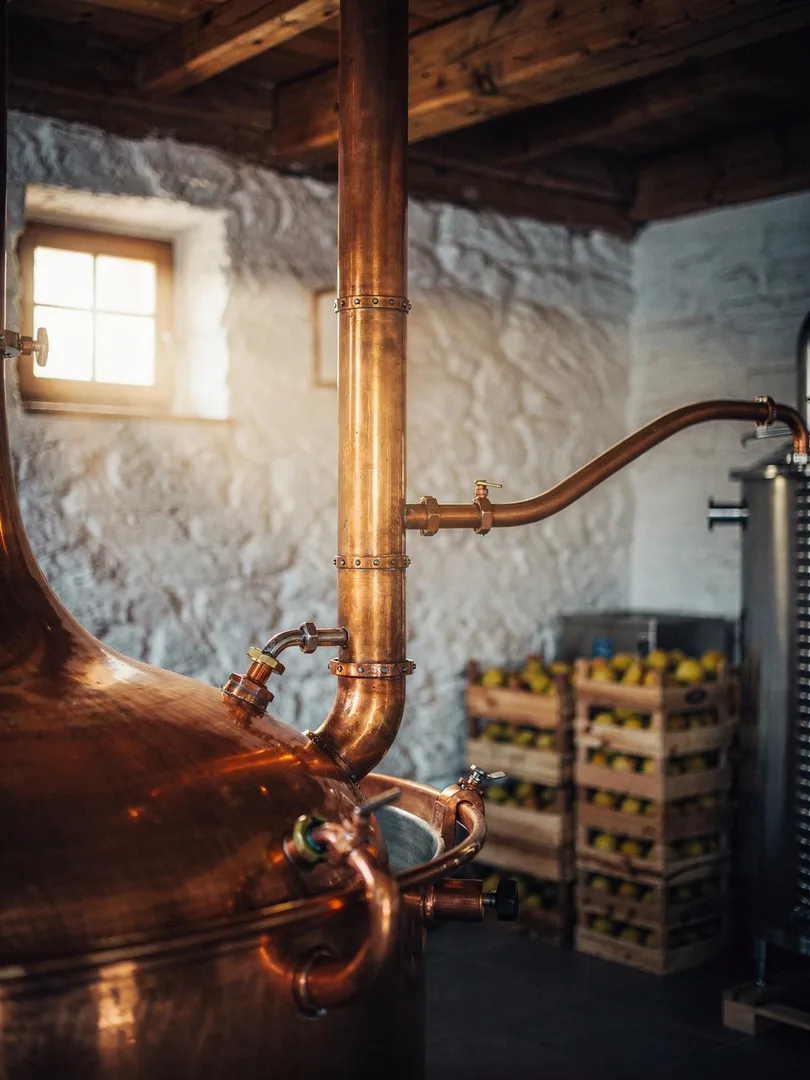
Still and Water Bath
Distilling
In autumn, the distillery smells of warm fruit. The fermented mash is poured into the pot still, a copper kettle that is heated. Alcohol boils at a lower temperature than water; the vapor rises, cools again in a condenser, and runs out as clear distillate. What's described here is the principle, not a recipe to follow at home.
Many fruit distilleries have a rectifying column mounted on the still, an attachment that purifies and enriches the vapor once more. The fruit brandy is then distilled in a single pass. Those who follow the classic double distillation first obtain a weak raw spirit and refine it in a second run. In both cases, the law simply requires that the distillate stay below 86 percent alcohol, so the fruit flavor is preserved.
What comes out of the condenser, the distiller divides into three parts. The heads come first, smelling sharp and containing volatile compounds; they are separated out. The heart is the centerpiece and is collected. The tails, with their heavy, oily aromas, are likewise set aside. Cutting these fractions only partially reduces methanol, which is why maximum limits apply to the finished product.
A special rule applies to pomace: the first distillation must take place with the pomace present, so pressed juice alone is not enough. Heating is done either directly with steam or after adding water, both methods are allowed.
The house of Psenner describes distilling in a water bath, where the kettle sits in hot water instead of over an open flame; this way the pomace doesn't scorch. Especially with Lagrein, whose pomace is thick and heavy, this is a sensible safeguard.