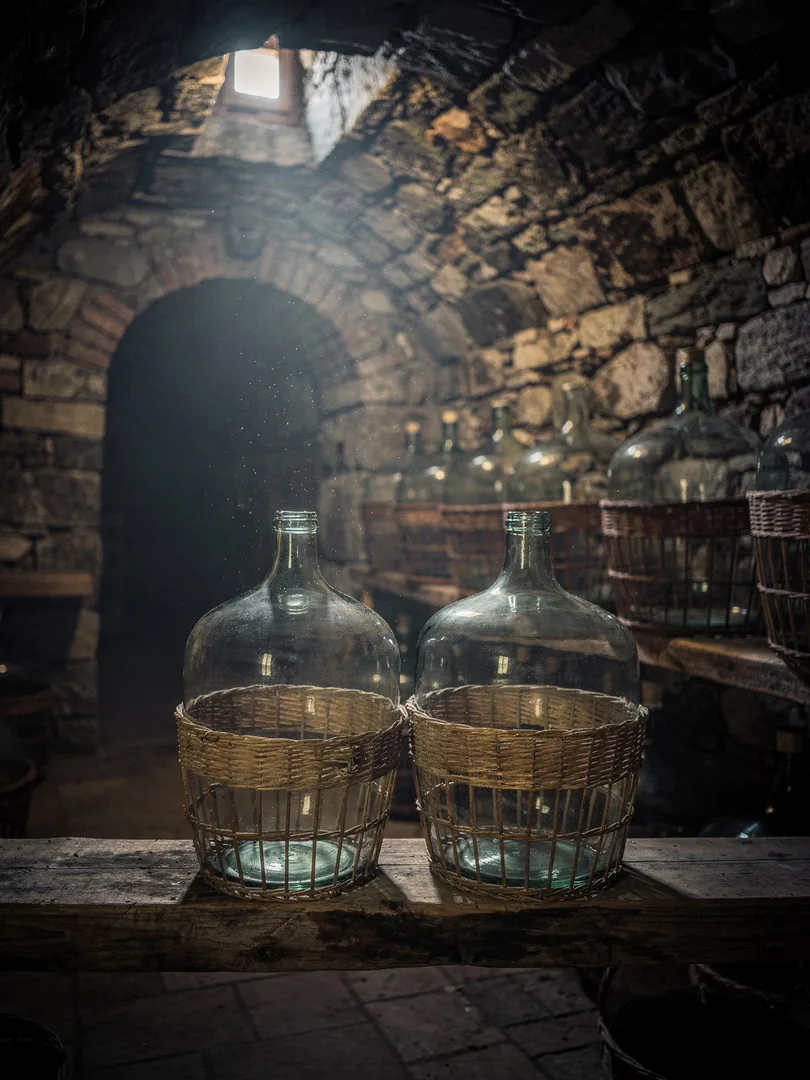
Demijohn Instead of Barrel
Maturation & Storage
Apricot brandy from the Vinschgau doesn't turn brown in a barrel. Most fruit brandies rest in neutral vessels, in glass demijohns or stainless steel tanks, and formerly in stoneware, so that the fruit aroma stays intact and the brandy remains clear. Wood is permitted, but not customary for clear fruit brandies.
There's a practical reason for the demijohns: glass imparts nothing to the brandy and is easy to clean. In a cellar on a farm in the Vinschgau or Eisacktal, the temperature barely shifts over the course of a year. Gentian brandy rests there too, allowing its robust root character to settle.
There's no minimum age requirement. The EU regulation prescribes no maturation period for fruit brandy or gentian, unlike brandy made from wine, which must rest in oak for at least six months to a year. It's therefore common for brandies from the Eisacktal or the Vinschgau to rest in demijohns for anywhere from a few months to a few years before bottling.
During this time, rough edges soften and the aromas come together. The demijohns stand dark and cool in the cellar, not by a window, since stone fruit brandies cannot tolerate light. Under light exposure, the hydrocyanic acid from the pits can form ethyl carbamate, and that's precisely what should be absent from the glass.
Only just before bottling is water added, bringing the brandy down to drinking strength. The regulation requires at least 37.5% ABV, though many brandies sit higher. This step, too, is part of the protected process for Südtiroler Zwetschgeler, since its specification requires it to take place within the Province of South Tyrol. How a barrel transforms color and flavor, on the other hand, is explained in the article on barrel aging in whisky.