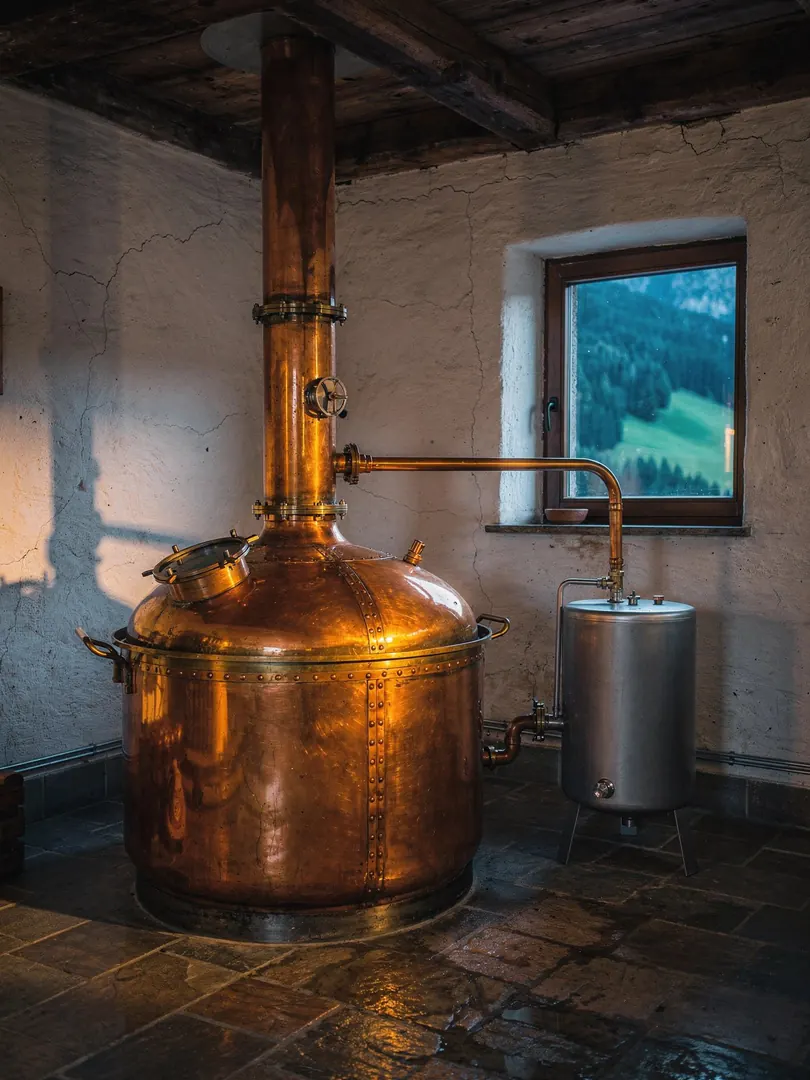
Pot with Column
Distillation
Distillation takes place in copper stills, usually fitted with a rectifying column. The mash is heated, the alcohol evaporates before the water does, and the vapor condenses back into liquid in a cooler. The result is a distillate far stronger than the mash it came from.
In the process, the distiller separates the distillate into three parts. The heads come first, smelling sharply of solvent, and are discarded. The heart is the core that later goes into the bottle. The tails bring heavy, fusel-like notes and are likewise cut away. Exactly where these cuts fall is a matter of the distiller's experience and nose, not a fixed table.
Methanol comes from the fruit's pectin and is present in every fruit brandy. Cutting the heads reduces it only partially, which is why legal maximum limits exist; for apricot and plum, the EU limit stands at 1,200 grams per hectoliter of pure alcohol. According to its specification, Südtiroler Zwetschgeler must also stay below 250 grams of ethyl acetate and below 250 grams of aldehydes per hectoliter.
For gentian, the only requirement is that it be the distillate of fermented roots at a minimum of 37.5% ABV. By comparison: Cognac, under its own rules, may only be distilled twice in the pot still, whereas fruit brandy from the Vinschgau is often finished in a single pass through a rectifying column. Distilling without a permit is prohibited in Germany, Austria and Switzerland.