Storing it properly
How long does fruit brandy keep? Storing it at home
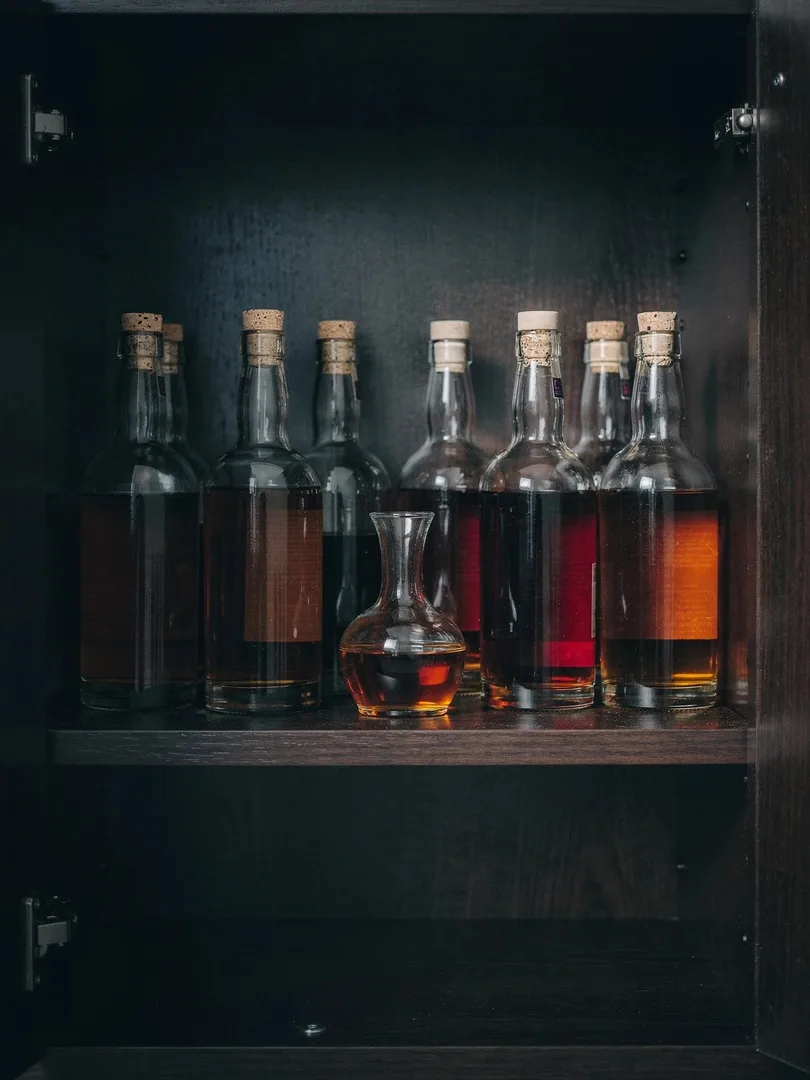
Unopened, fruit brandy keeps virtually indefinitely, since drinks above 10% ABV are not required to carry a best-before date in the EU. Once opened, it loses aroma gradually over months and years. It's best kept in a dark, cool spot, standing upright, since light can cause ethyl carbamate to form in stone-fruit brandies.
How long does fruit brandy keep? There's no expiration date
Look as you might, you won't find a best-before date on a bottle of kirschwasser, Williams, or Cognac. The Food Information Regulation (EU) No. 1169/2011 specifically exempts drinks with 10% ABV or more. At 37.5% ABV or above, microbes can't grow, so the spirit doesn't spoil.
Keeping well, though, doesn't mean staying unchanged. What does change is the aroma. In a well-sealed, unopened bottle, little happens over many years. True maturation doesn't take place in the bottle, since there's no wood involved. A fruit brandy stored in a cupboard for twenty years isn't older in flavor—at best, it has simply stayed the same.
Liqueurs are a somewhat different matter. They often contain less alcohol and a lot of sugar, sometimes cream or egg as well. Such drinks aren't true spirits and often carry a date. For pure spirits like kirschwasser, obstler, or brandy, however, the rule holds: the bottle doesn't spoil, at most it loses some of its aroma.
An opened bottle: what air and time do to the spirit
Once opened, air comes into play. Every time the bottle is opened, volatile aromatic compounds escape, and fresh oxygen gets in. The delicate fruit aromas of a raspberry eau de vie or a Williams pear brandy are especially sensitive. They fade first, while the alcohol and heavier notes remain.
The emptier the bottle, the more air sits above the spirit, and the faster this happens. A half-full bottle changes noticeably quicker than an almost full one. If you want to keep a small remainder longer, decant it into a smaller bottle filled right up to just below the cap.
There's no fixed timeframe to give, since spirit, closure, and storage conditions vary too much. As a rough guide: within a few months, well-sealed bottles show barely any change; after several years with a lot of air in the bottle, the difference is often noticeable. Wood-aged spirits generally tolerate time a bit better than delicate fruit brandies from glass.
Why light harms stone-fruit brandy
With brandies made from cherries, plums, apricots, or mirabelles, there's an additional reason for dark storage. The pits of these fruits contain amygdalin, which can give rise to hydrocyanic acid. Regulations limit this to no more than 7 grams per hectoliter of pure alcohol in fruit brandy. Under light, traces of this in the finished spirit can turn into ethyl carbamate, a substance classified as carcinogenic.
Germany's Federal Institute for Risk Assessment cites a guidance value of 0.4 milligrams per liter for this. Distillers therefore work carefully with the pits and store their distillates away from light. The same applies at home: a clear bottle of kirschwasser doesn't belong on a sunny shelf or windowsill, but in a cupboard or its original box.
For other spirits, light is less of a concern, but it's still not harmless. It can alter color and aroma, especially in wood-aged spirits bottled in clear glass.
Standing or lying down, warm or cold?
Unlike wine, spirits are stored standing up. With wine, the cork needs to stay moist so it doesn't dry out. For a spirit at 40% ABV or higher, distillers and retailers recommend the opposite, since strong alcohol can damage a natural cork over time. The cork becomes brittle, crumbles, or imparts flavor to the spirit. With screw caps, position matters less, but standing upright remains the safest choice.
As for temperature, a consistently cool spot is enough—a cupboard in the hallway or a cellar works well. Strong heat from heating systems or sunlight speeds up evaporation through the closure and harms the aroma. A refrigerator isn't necessary for storage. Whether a spirit should be served cold is a matter of taste, not of shelf life.
Follow these rules, and a good bottle will bring you lasting enjoyment. Dark, cool, upright, and well sealed: that's all a spirit needs in your own home.