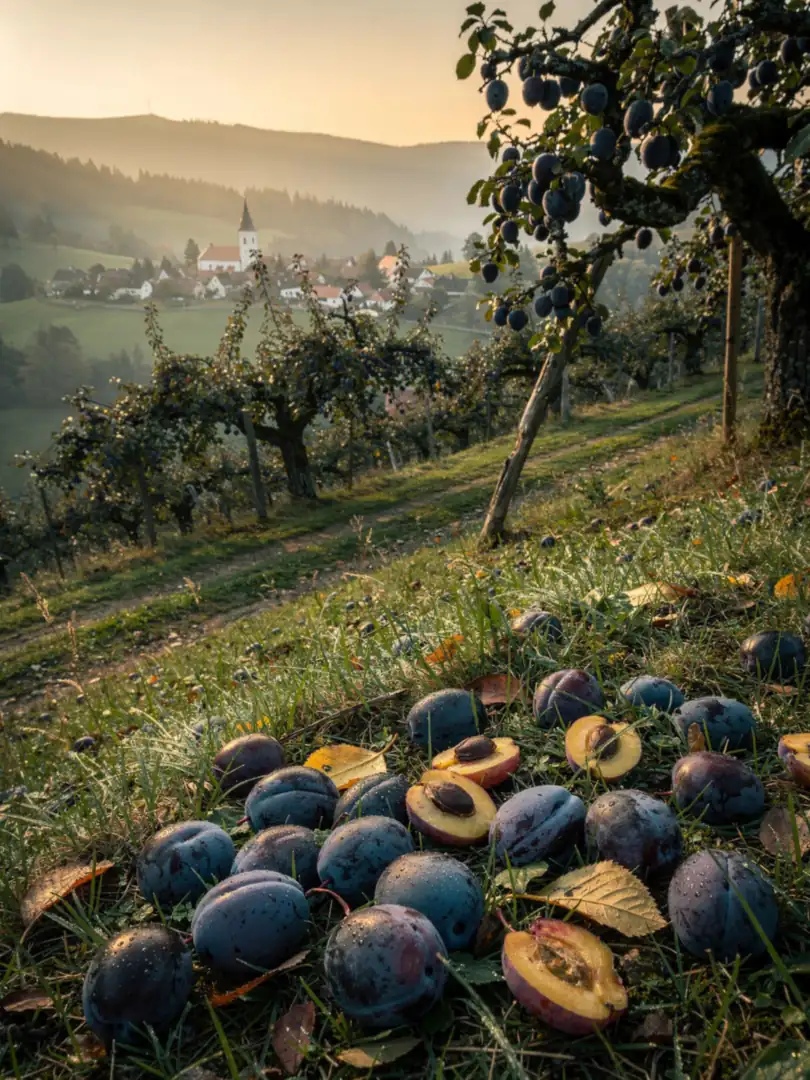
Plums on the Hillside
Fruit & Raw Material
In late summer, the plums in the hills of Wallachia turn blue-violet, and many trees don't stand in neat rows but along field edges and paths. According to a Czech exhibition on slivovice, plums in Wallachia were originally not planted in orchards or grafted, but grown from cuttings and suckers. They marked the boundaries between fields and helped hold water on the steep slopes.
Which plums are used for slivovice? Mostly Zwetschgen, known in Czech as švestky, with firm flesh that separates easily from the pit and brings plenty of natural sugar. Legally, slivovice is a fruit brandy made from plums, and EU regulation doesn't require a specific variety. Unlike the Williams pear, whose name is tied to a single variety, the distiller here has more freedom.
In Slovakia, around Bošáca in the Trenčín region, the Bystrica variety, known locally as bystrička, is cited as the traditional raw material for slivovica. According to local accounts, it has at times been replaced by other varieties. This shows how flexible the notion of variety really is: what matters more than the name of the variety is what actually ripened on the tree.
Ripeness is what really counts. Unripe fruit gives thin, green notes, while overripe or rotting fruit brings vinegar and off-flavors into the mash. That's why distillers collect windfall fruit early and process it quickly, before it ferments where it shouldn't.
For small farmers, the plum is therefore less a market commodity than a raw material for the family. Anyone with just a few trees on a hillside brings the harvest to a custom distillery instead of selling it at a loss, and gets back a shelf-stable brandy that lasts through festivals, visits, and weddings. Between the trees and the bottle lies a single season.