Craze, Law, Comeback
Region & History
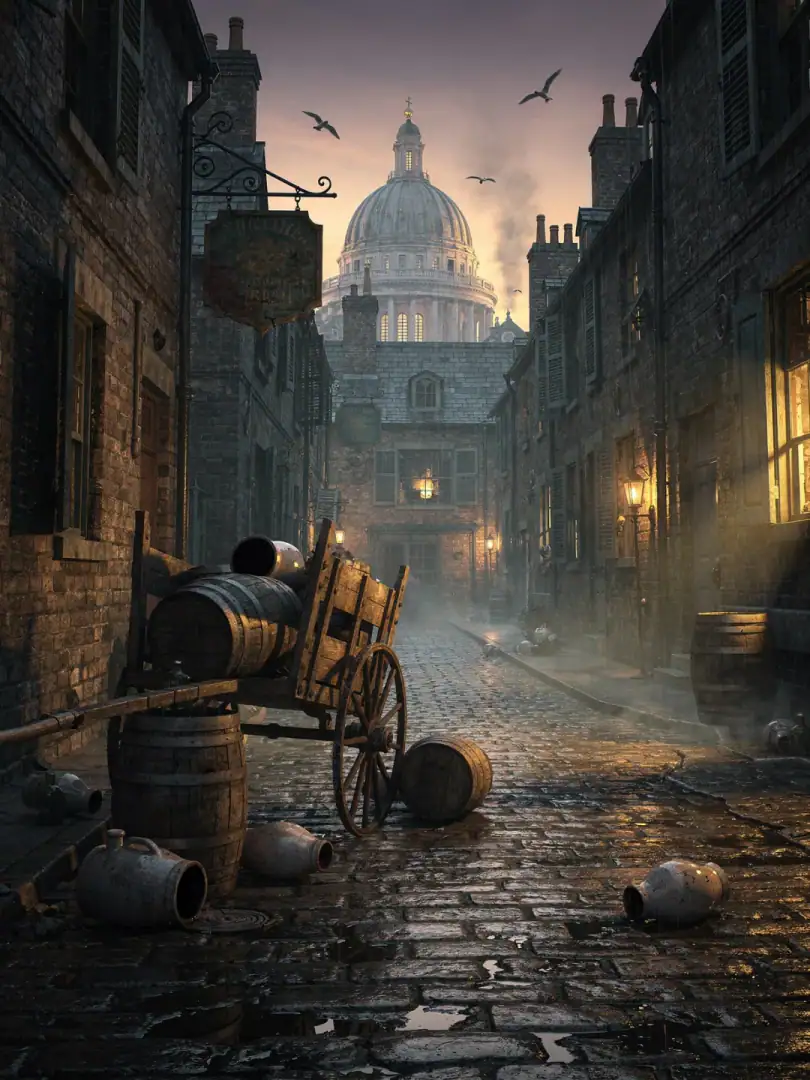
Around 1720, some corners of London smelled more of juniper than of coal. Gin was cheap, strong, and available everywhere — from cellars, carts, and open windows. Within a few decades, the city drank itself into a frenzy that would later be called the Gin Craze.
Parliament responded with the Gin Act of 1736. Anyone wanting to sell gin needed a license costing fifty pounds a year, plus a tax of one pound per gallon. The rule hit the wrong people: over the following seven years, only two licenses were issued, while the black market flourished and adulterated rotgut left people blind.
In 1751, a second law followed, milder in its fee but stricter in its control: only those running a public house with an annual rent of at least ten pounds were permitted to sell. Combined with rising grain prices, consumption genuinely collapsed by 1757. Over a hundred years later, the glamour returned, this time with gaslight and mirrors: the Victorian gin palaces, where even poor neighborhoods could sparkle for an evening.
One single address runs right through the middle of this story: in 1863, James Burrough bought a small distillery in Chelsea and soon named his gin Beefeater. Since 1958, it has been distilled in Kennington, in a former military pickle factory building.
For almost two hundred years, no one in London was allowed to set up a new small copper pot still, because an old law required minimum sizes no small operation could manage. That finally changed in 2009: Sam Galsworthy, Fairfax Hall, and Jared Brown received the first license for a small still in almost two centuries, after a two-year battle with the authorities. They named their still Prudence.
Today, copper stands in the city once again: Charles Maxwell has been distilling at Thames Distillers since 1996, and on Bride Lane, right in the heart of the City, the City of London Distillery has been distilling since 2012. Juniper is back — this time without a ban.