The short answer
London Dry describes how a gin is made, not where. It can be produced anywhere in the world. The term also says nothing about how any particular bottle tastes.
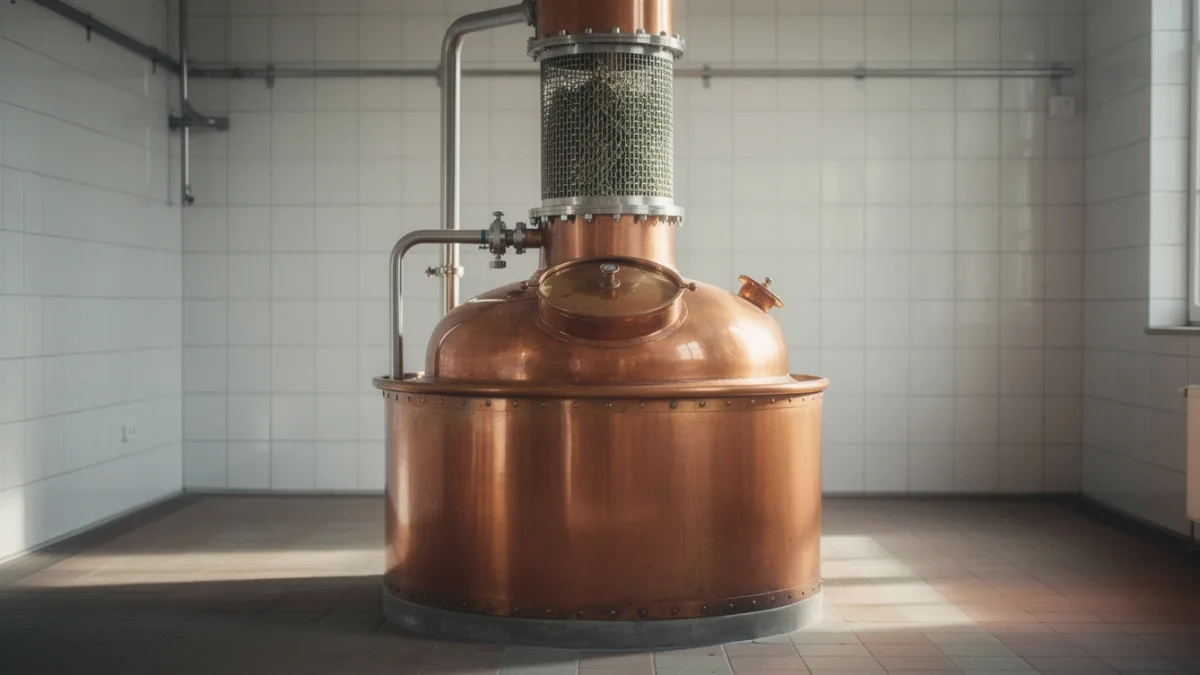
Distinguishing place and method
London Dry is a method of production. The alcohol is redistilled together with the botanicals, and adding anything afterward is strictly limited. There's no protected London origin behind the name.
Distilling means: the liquid is heated, the vapor is captured and then cooled again. With London Dry, the botanicals are involved at this very moment. That's exactly where the flavor is created.
The name comes from an era when the method was developed in London. What remains is the technique, not the place. Today London Dry is made in Spain, Scotland, Germany and elsewhere. That's entirely within the rules — there's no cheating involved.
What the designation actually restricts happens after distillation. Flavors may not be added afterward. Sweetening is allowed only within very tight limits. So the flavor has to come from the distillation itself. Many well-known brands carry this label, and they still don't all taste the same.
The word 'Dry' points exactly to this. A London Dry isn't sweetened afterward, at least not in any meaningful amount. 'Dry' here means: without sugar added after distillation.
That's a serious restriction. It's just not a geographic one. Reading 'London Dry' tells you something about the craft and nothing about the map.
How to use the designation
When shopping, London Dry is information about the method. The important questions remain open after that. How juniper-forward is this bottling? What other impressions define it? And what do you want to use it for? These questions can only be answered by the individual bottle, never by the term.
So take the designation as a starting point, not a selection criterion. Two London Dry gins can differ more from each other than a London Dry and a gin without that designation. The style description on the back tells you more about the taste than the lettering on the front.
One example makes this clear. Two bottles both say London Dry. One is strictly juniper-forward, the other full of citrus peel. Both follow the same rule, because the rule only describes how the gin is made.
Try a new gin first in a simple drink with a mixer you already know. Don't change the tonic, garnish and ratio all at once. Otherwise you won't be able to pin down the difference afterward.
London Dry also isn't a price tier. Gins without this designation can be just as convincing — they're simply built differently.
Feel free to keep a small list. Note which bottle you liked, and next to it, its style description. After a few purchases, you'll recognize your own pattern, and that pattern will help you more than any label.

What London Dry means for your shopping
Three questions come up again and again in the shop. The answers show that London Dry settles less than the term suggests.
| Question | Clarification |
|---|---|
| Does it have to come from London? | The term describes a method of production, not necessarily this place. |
| Do all London Dry gins taste the same? | Botanicals and the specific method can differ. |
| Does it automatically suit any tonic? | Mixing ratio and mixer still need to be matched. |