Bog and Hedgerow
Botanicals
Juniper grows only sporadically in Ireland. It's usually found on barren limestone slopes and open heathland, never in the dense stands seen in central Europe. Most Irish distilleries therefore buy in their juniper berries, typically from Macedonia or Italy. Instead, they build the regional character into the second and third ingredients.
At Glendalough in the Wicklow Mountains, that means up to 37 wild plants. A full-time forager picks them by hand: wood sorrel for a grassy tartness, elderflower for sweetness, fir needles for a resinous undertone. Freshly picked material wilts quickly, so it travels from mountain to still within a few hours.
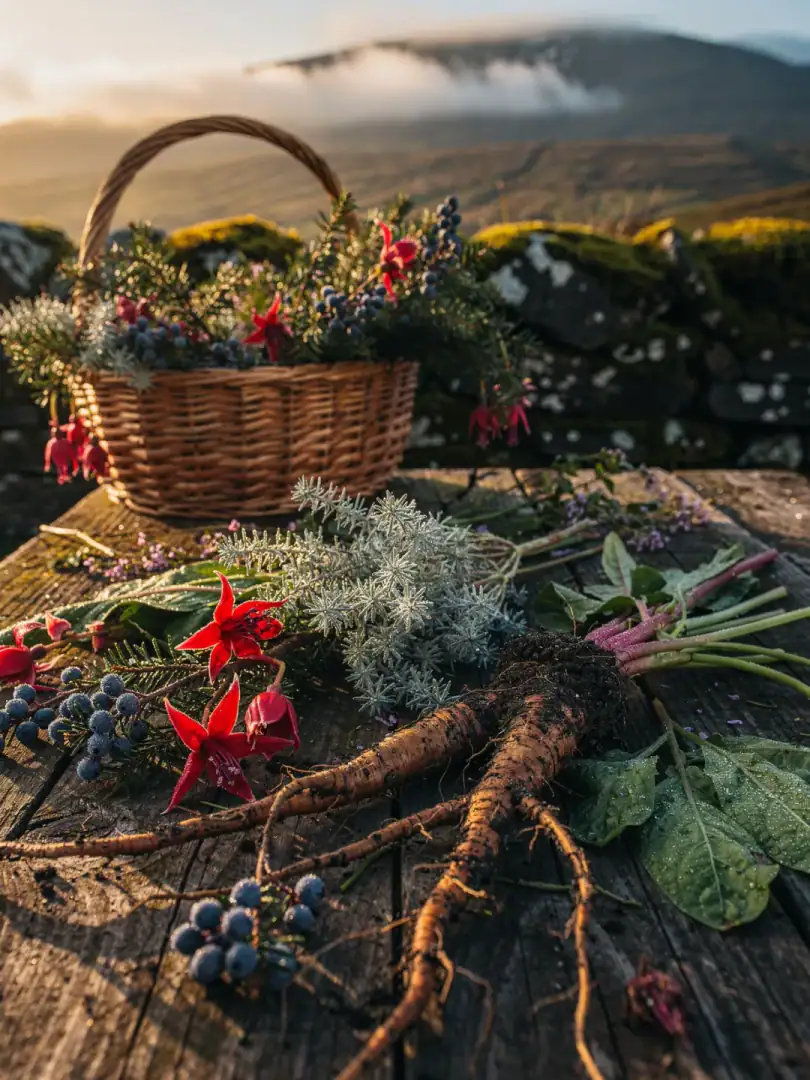
On the Dingle Peninsula in Kerry, different plants shape the gin. Fuchsia hangs with its red blooms from nearly every hedgerow. Rowan berry, bog myrtle, angelica root, chervil, heather and hawthorn round things out, all gathered on the peninsula itself. Fuchsia lends a slightly bitter, floral note. Bog myrtle recalls resin and mint at once, coming from a shrub that grows precisely in the damp bogs so characteristic of Kerry and much of western Ireland.
In Drumshanbo, The Shed Distillery takes a different path. It blends twelve botanicals from nine countries, eight slowly macerated in copper pot stills, four introduced by vapour infusion. According to the distillery, the combination of Chinese gunpowder tea and native meadowsweet is meant to bring together a smoky, minty edge with a honeyed, floral side. The juniper doesn't disappear in the process.
Coastal proximity plays a role at several houses. Dried sea kelp from the Atlantic coast, gathered around islands like Achill, appears in smaller batches as a salty background note. It brings iodine and an umami-like aroma. Many Irish distilleries simply treat their shoreline or their bog as a shopping list of ingredients.
The result is a picture that shifts from region to region, even though the same juniper sits at the core throughout. Here it's damp and boggy, there it's floral and hedgerow-fresh, elsewhere it's briny from the sea. A remnant of imported base spirit is almost always present, since the island's climate is simply too mild and too wet for juniper alone.
Sphagnum moss and heather form a spongy, permanently damp surface.
The root: Bog myrtle and heather anchor only shallowly here, since barely any oxygen reaches deeper down.