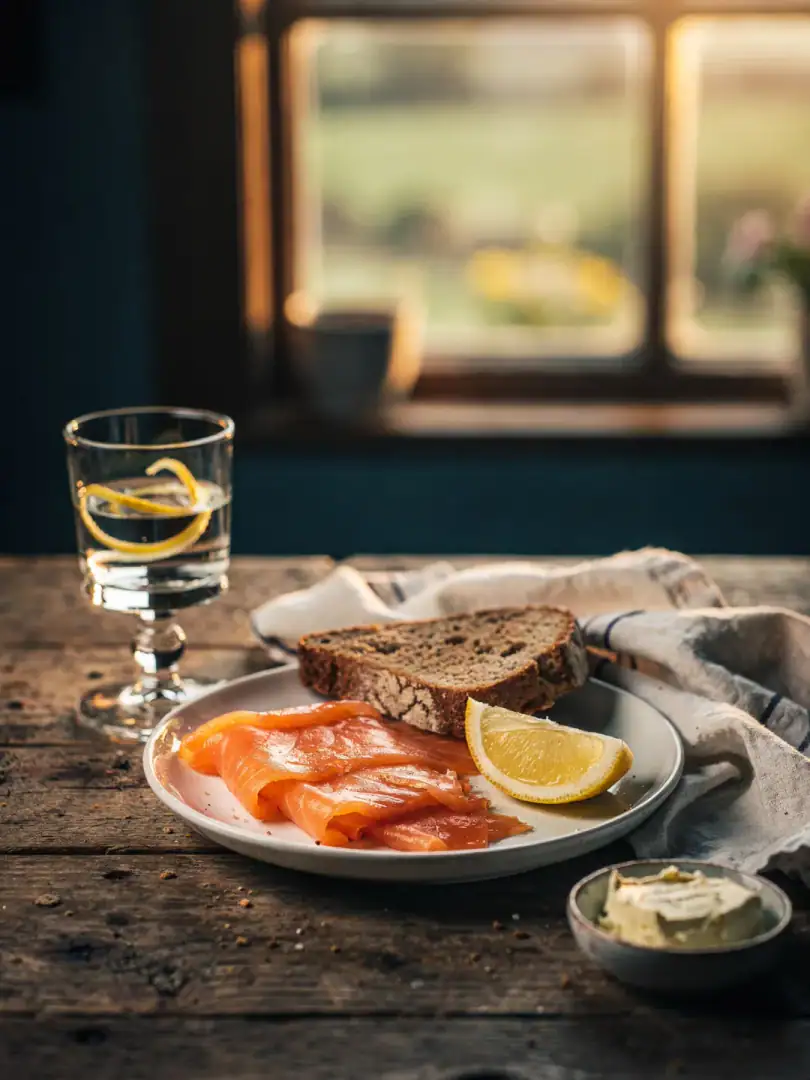
Salmon and Oysters
Gin & Food
Ireland's cuisine lives off the coast, and that's precisely where it meets the country's gin, which itself often tastes of salt, herb and bog. Cold-smoked Irish salmon, thinly sliced, ranks among the country's best-known dishes. It pairs well with a herbaceous, floral gin like Dingle Original, since its fuchsia and heather notes complement the smoke rather than masking it.
Oysters from Galway Bay or from Carlingford in the north are usually served with nothing more than a squeeze of lemon. They harmonise beautifully with a briny, herbaceous gin infused with dried sea kelp from the Atlantic coast. The iodine in the gin picks up the oyster's own iodine note instead of overpowering it.
Irish stew, a slow-braised dish of lamb, potatoes and carrots, calls for a bolder counterpart. Drumshanbo Gunpowder Irish Gin, with its smoky tea note and spicy finish, stands up well to the hearty stew, much like the strong tea traditionally served alongside it.
Soda bread, the dense, slightly tangy loaf made with buttermilk and baking soda, is often eaten with salted butter and smoked fish. A more delicate, floral gin like Glendalough Wild Botanical suits it well. Its green, fresh aromas pick up the bread's tartness without competing against the rich butter.
The same rule applies across all these pairings. The gin is served neat or as a simple gin and tonic, never as an ingredient within the dish itself. It remains a companion, highlighting individual flavours on the plate, whether the smokiness of the salmon or the salinity of the oyster.
So the same picture emerges at the table as in the glass. Irish gin remains landscape in liquid form, sometimes bog, sometimes hedgerow, sometimes sea. That's precisely why it pairs so well with dishes built from the very same ingredients.