Grain Instead of a Herb Garden
Botanicals
In most gin regions, herbs and citrus take center stage. In Schiedam, it's different. Here, it's the grain that shapes the flavor first, not the juniper. Rye, corn, and malted barley are fermented and distilled into Moutwijn, a malt wine with roughly 40 to 80 percent alcohol. On its own, it already tastes like a light, grainy bread.
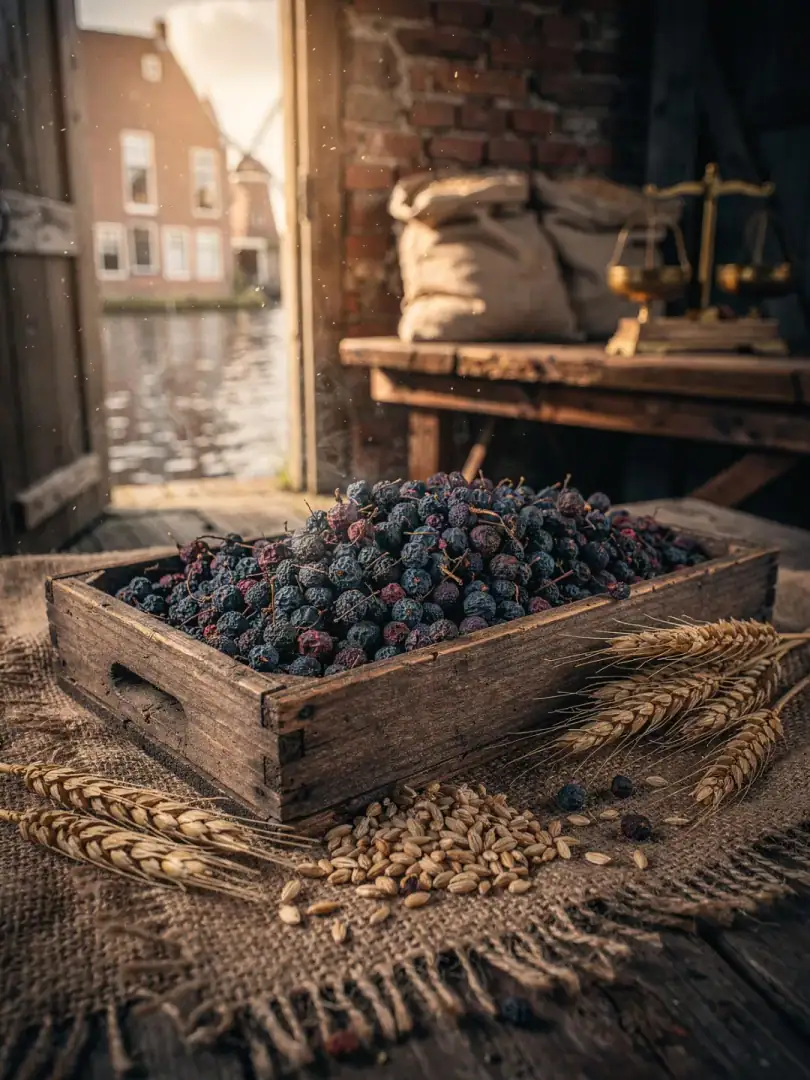
The juniper that gives Genever its name doesn't grow in the polders around Schiedam. Holland's damp, flat climate is poorly suited to the shrub. Juniperus communis grows wild more on the sandy heathlands in the east of the country, such as the Veluwe. Historically, though, the juniper for the distilleries mostly came from southern and eastern Europe, arriving in Schiedam via the Rhine and maritime trade. Nolet Distillery also sourced its juniper this way.
Genever needs significantly less juniper than a London Dry. The flavor of the grain stays in the foreground. Traditionally, other ingredients were added as well, such as anise or caraway. They complemented the spice without overpowering it. The result is a drink that recalls toasted bread with a hint of pine more than a classic, herb-forward gin.
The result is a balancing act between two worlds. Too much juniper, and the character of the Moutwijn is lost. Too little, and all that's left is a plain grain spirit with no distinctive identity. That's why master distillers in Schiedam, over generations, chose ratios that deliberately let the grain's base tone shine through.
On the heathlands of the Veluwe, it becomes clear just how undemanding juniper is. It grows in poor, acidic sandy soil that hardly any other plant can tolerate. Deep beneath the heather often lies a hard, iron-rich layer, the ortstein. It traps water and forces the roots to grow sideways instead of deep, exactly where the shrub draws its strength from.
Nutrient-poor, acidic sand beneath the heather cover.
The root: Juniper tolerates drought here because its roots stay shallow.