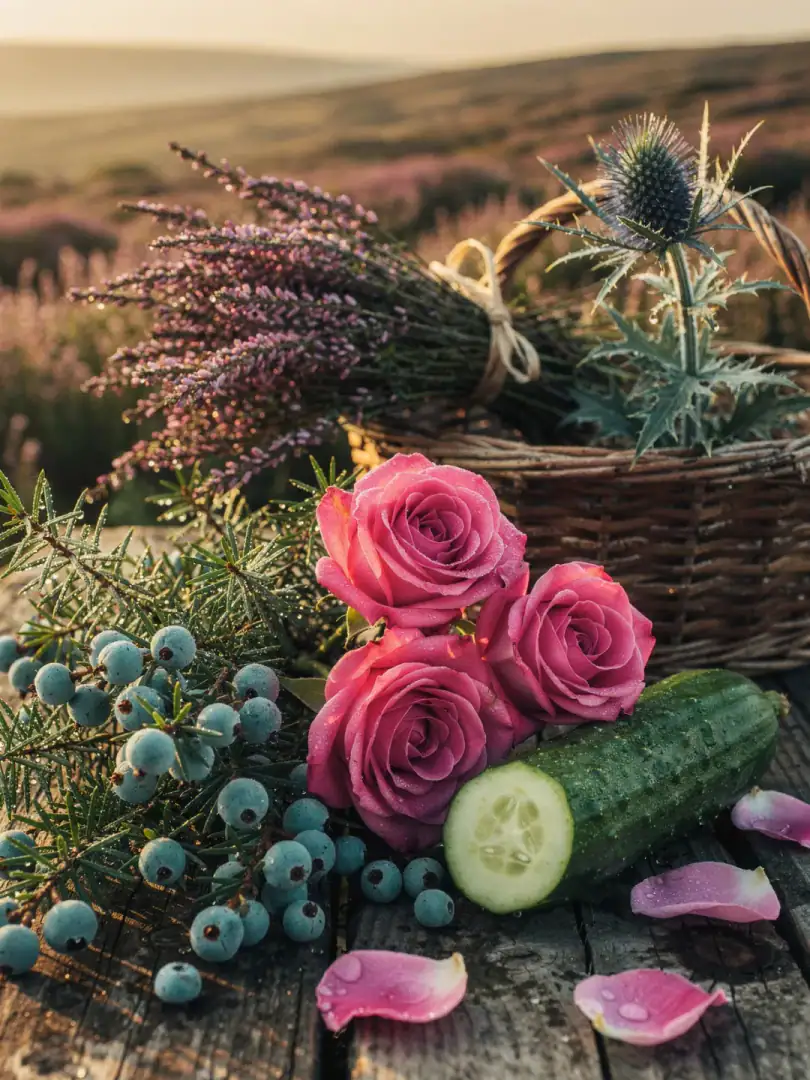
Rose, Juniper, Thistle
Botanicals
Juniper is mandatory here too, but it doesn't grow on the flat farmland of the Lowlands. The bushes stand in the hills south of Edinburgh, in the Pentland Hills, where heather and gorse cover the boulder clay soil. What defines this region isn't the juniper itself, but what the distilleries pair with it.
At Hendrick's, made in Girvan, that's mainly rose and cucumber. Developer Lesley Gracie lets nine botanicals macerate, that is, steep in alcohol, for at least fourteen hours before distillation. Bulgarian rose oil and cucumber essence are added afterward, after distillation, not before. That's why Hendrick's tastes less of pine forest than many other gins, and more of a flower shop and cucumber salad.
Edinburgh Gin uses fourteen botanicals, including lavender, pine buds, mulberries, hazelnuts, and, according to the distillery itself, Scottish heather and milk thistle. Heather lends a slightly honeyed note, while milk thistle brings a dry, almost herbal bitterness that mirrors the sweet rose note in Hendrick's, only rougher and more austere.
Cucumber cools the impression in the mouth before the juniper even arrives. Rose settles over the tongue like a scent, without tasting perfumed, as long as the amount is right. Together, these explain why a gin from this region often feels softer than a sharp London Dry.
So from the same mandatory ingredient, juniper, Girvan produces a floral, green gin, while Edinburgh produces a spicy, herbal one, even though the two are only a few miles apart.
Decaying heather and moss, dark and slightly sour.
The root: Heather anchors itself with fine fibrous roots just below the surface.