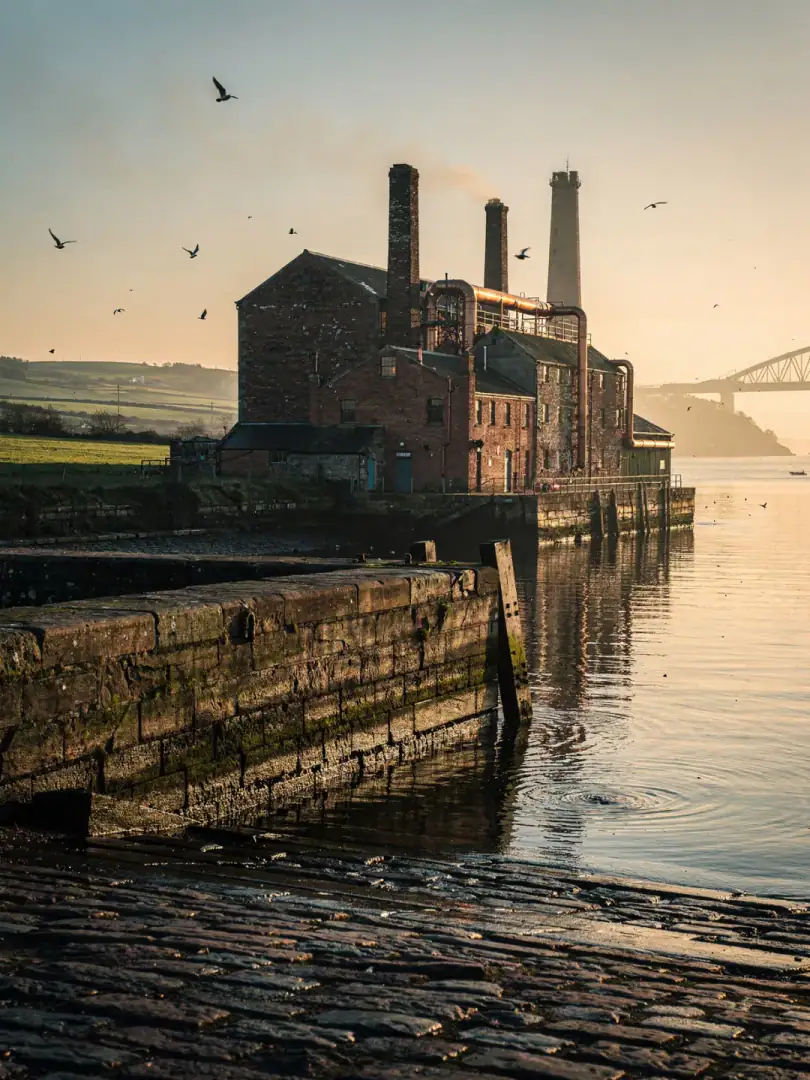
Copper on the Firth
Region & History
On the eastern edge of Edinburgh, where the Lowlands meet the waters of the Firth of Forth, lies the village of Cameronbridge. From the outside it looks like any other place in Fife, fields all around and gulls over the rooftops. Inside stands one of the largest spirits facilities in Europe, and hardly anyone driving past suspects how much gin flows through these pipes.
The grain distillery Cameronbridge was founded in 1824 by John Haig, for whisky, not gin. In 1877 it became part of the Distillers Company Limited, a merger of several grain distillers that over many decades grew into today's Diageo. Since 1998, gin has also been distilled at Cameronbridge: Gordon's and Tanqueray, two of the best-selling gin brands in the world, both come from the same copper stills as part of the base alcohol for Smirnoff vodka.
About an hour's drive southwest, on the Ayrshire coast, William Grant & Sons operates the Girvan distillery, known mainly for grain whisky. Since 1999, Hendrick's has also been made there, developed by chemist Lesley Gracie. Two mismatched stills shape the gin: a small 1860 pot still, built by Bennett, Sons & Shears, and a 1948 Carterhead still, in which the botanicals don't boil along but simply hang in the vapor.
Edinburgh itself joined later. In 2010, Alex and Jane Nichol founded the Edinburgh Gin brand, initially sold on a small scale at garden fairs. In 2014, their own distillery opened on Rutland Place, right in the heart of the New Town, with two tiny 150-liter stills. Since 2024, production has continued in a new, larger building in the heart of the city.
Three very different places, then: an industrial site on the Firth of Forth, a grain distillery on the west coast, and a small city distillery in Edinburgh. Together they explain why a large share of all British gin today comes from Scotland.