What's Allowed
Sugar and Color
Can gin be sweetened or colored at all? The answer depends on the category: what's permitted for simple Gin is almost entirely banned by the regulation for London Gin.
Sweetening: permitted, but within limits
Simple Gin and Distilled Gin may be sweetened to soften the sharpness of the alcohol. The regulation permits various sweeteners for this purpose, such as sugar, honey, or certain syrups. However, the finished sugar content may not exceed a certain limit, otherwise the spirit would shift into a different category, such as toward liqueur, and would then have to be labeled accordingly.
London Gin, by contrast, allows virtually no sweetening at all. At most 0.1 grams of sugar per liter is permitted, an amount that's barely perceptible on the palate. That's why London Gin almost always tastes drier than other categories. This also explains why the term Dry historically came about, even though it no longer has to appear on the label today to make the category unambiguous.
Coloring: allowed for Gin, banned for London Gin
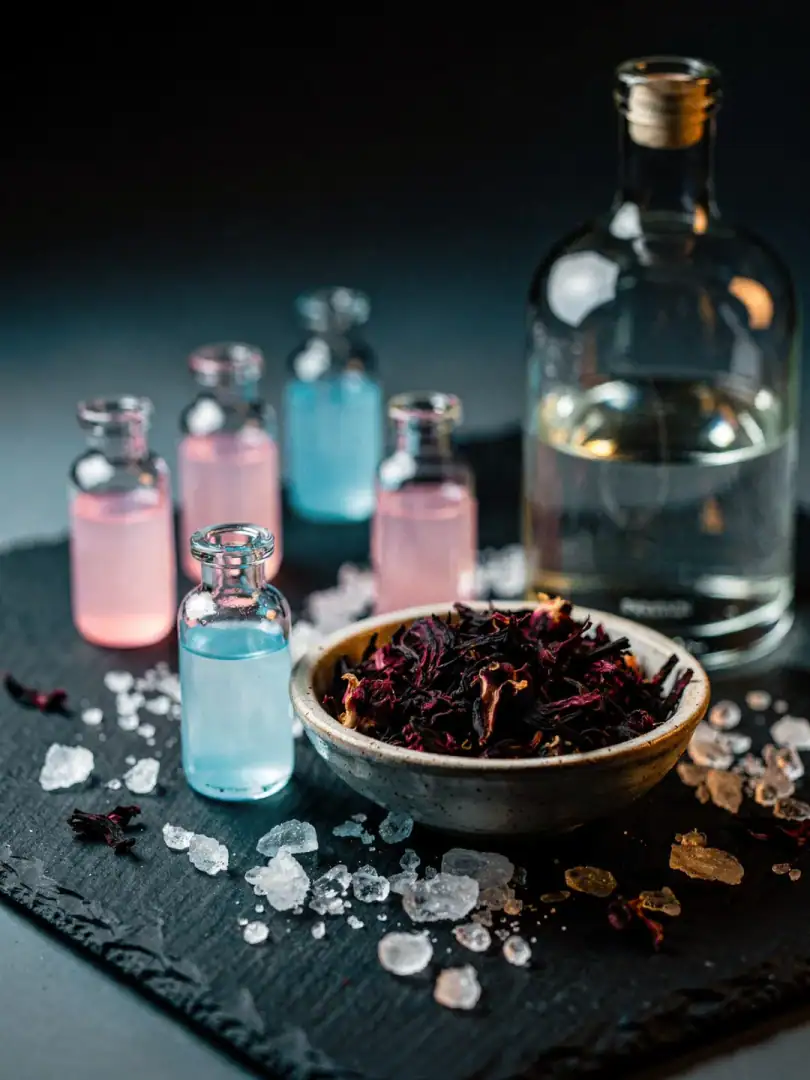
A pale rosé or blue tint in the glass almost always comes from added colorings, whether natural ones like hibiscus or artificial variants. For Gin and Distilled Gin, this is generally permitted. The coloring agent must be correctly stated on the label, as required by general food labeling rules anyway, usually under an E-number or the spelled-out plant name.
After the final distillation, London Gin can barely absorb anything else besides water and matching alcohol. Colorings included. A colored London Gin would therefore be a contradiction in terms. Either the category statement is incorrect, or the color genuinely comes from the botanicals distilled along with it, which occasionally happens with strong green or yellowish hues.
Why some gins change color
A well-known trend involves gins that change color when tonic water is added. The effect usually relies on plant pigments such as anthocyanins, which react to changes in acidity. This is a visual trick. It doesn't change the legal classification as Gin or Distilled Gin, as long as the other rules are followed and the category is stated correctly.
Such effects are purely showpieces for the sales counter. They say little about the quality of the botanicals. Anyone wanting to judge a gin's true character should rely less on color and more on the stated alcohol content and the category on the label, even though the color change in the glass is admittedly a pretty sight.
What this means for shopping
If a colored or noticeably sweet gin is labeled London Gin, a second look at the label is worthwhile. It may actually belong to a different category, or be a flavored product that carries the word Gin only as part of its brand name, not as a legal category, something that can easily be mistaken at first glance.
As a general rule: the stricter the category, the less room there is for sweetening and coloring. Anyone seeking a particularly unadulterated, dry juniper flavor is more likely to find it under the designation London Gin than among flashily marketed special editions that lack this category label, even if their presentation looks more elegant at first glance.
A well-known example of a color-changing effect is Blue Butterfly Pea, botanically Clitoria ternatea. Its blue flowers contain the pigment anthocyanin, which is sensitive to pH levels. Add acidic tonic water, and the color shifts from blue to pink or violet. The same mechanism is behind many red-colored berry liqueurs, such as elderberry or hibiscus. Chemically, this is usually the additive E163, an approved natural colorant. With sloe gin, however, the deep red color comes without any additive at all: it comes purely from the macerated sloe berries, which release their color into the alcohol during maturation.