A style, not a place
London Dry Gin
London Dry Gin is the world's best-known gin style, and the name is misleading: it doesn't have to come from London at all. It describes a production method, not an origin.
What is London Dry Gin? The definition
EU Spirit Drinks Regulation (EU) 2019/787 sets out what a London Dry Gin is allowed to be. The base alcohol must be neutral and of agricultural origin. All flavor must come from a second distillation with natural botanicals such as juniper, coriander, or citrus peel, never from flavorings or coloring added afterward. After this distillation, only water and ethanol of the same quality may be added, along with no more than 0.1 grams of sugar per liter. The minimum alcohol strength is 37.5% ABV, though most well-known brands sit at 40% or higher.
These rules make London Dry Gin the strictest of the classic gin styles. A producer in Berlin, Kraków, or Cape Town can call their product London Dry Gin just as legitimately as a distillery in England, as long as they follow the process. The name therefore denotes a production standard, not a protected geographical indication like Genever.
In the US, a separate rule applies under 27 CFR Part 5: there, gin in general must be at least 40% ABV, regardless of the specific style. So comparing an American bottle with a European one, you'll find slightly different legal minimums, even though both may be labeled London Dry Gin. In practice, at the bar, this difference barely matters, since most brands sit well above their respective minimums anyway.
What does London Dry Gin taste like?
The taste is dry, clean, and juniper-forward. Right behind that usually come citrus notes of lemon or bitter orange, along with the spicy bite of coriander seed and sometimes a hint of angelica or orris root. Sweetness plays virtually no role, since residual sugar is practically ruled out by law. Anyone tasting London Dry Gin for the first time usually notices the cool, herbal sharpness first, and only afterward the finer citrus layer underneath.
This clarity makes the style versatile. It pairs with almost any tonic water, since it doesn't bring a dominant sweetness of its own that would compete with the tonic. That's exactly why London Dry Gin is often the first choice for beginners and the reliable building block in classic cocktails.
This dryness is closely tied to the distillation method. Because all the flavors are created during distillation and nothing is added afterward, no sugar remains that could soften the impression. This clearly sets London Dry Gin apart from sweetened styles like Old Tom Gin, and explains why many bartenders prefer it as a neutral base for recipes that already bring their own sweetness, such as through syrup or vermouth.
Well-known examples of London Dry Gin
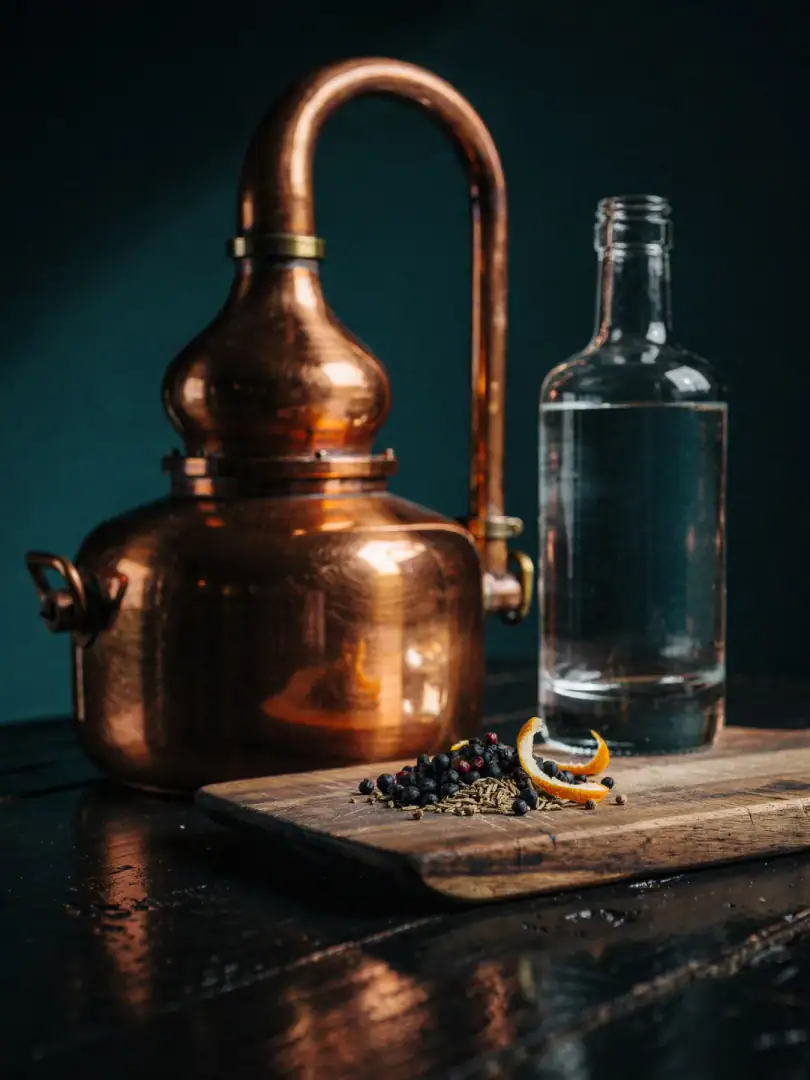
Among the best-known bottles are Tanqueray, Beefeater, and Gordon's, all three on the market for decades and all three clearly juniper-forward. Beefeater also distills with citrus peel, giving it a brighter, fresher note. Tanqueray relies on a small number of bold botanicals, giving it a particularly streamlined character. Newer distilleries like Sipsmith, based in London itself, show that the style also works on a small scale, with a traditional copper still and hands-on craftsmanship.
Tasting these bottles side by side quickly reveals that, within these strict rules, there's still room for individual character. The choice of botanicals and their ratio to one another set the brands apart, even though all fall under the same legal definition.
Distilleries outside Great Britain have also embraced this style. In recent years, Germany, Spain, and the US have seen numerous small distilleries deliberately labeling their products as London Dry Gin, to signal the familiar, dry style to buyers. The name thus functions almost like a seal of quality for a particular flavor profile, regardless of where it's actually made.