Preparation
- Rub the flour, butter, icing sugar and salt together with your fingertips or in a food processor to fine crumbs, add the egg yolk and water and mix only until the dough comes together; do not knead.
- Roll out the dough and line a 23 cm tart tin with it, pressing it against the sides. Prick the base several times, cover with baking paper or foil and fill with pulses, then chill for 30 to 60 minutes. Simply press any cracks in the pastry back together.
- Put a baking sheet in the oven and preheat to 200 °C (conventional) / 180 °C (fan). Place the tin on the sheet and blind bake for 15 minutes. Remove the foil and pulses and bake for another 5 to 8 minutes, until the base is light golden. Then reduce the oven to 180 °C (conventional) / 160 °C (fan).
- For the filling, mix the cornflour, sugar and lemon zest in a pan, gradually stir in the lemon juice, then add the orange juice (topped up with water to 200 ml) and thicken over medium heat, stirring constantly, until smooth.
- As soon as the filling bubbles, take it off the heat and stir in the butter. Whisk the egg yolks and whole egg, stir them in and return the pan to medium heat. Stir vigorously until the mixture plops off the spoon; it may bubble but will not curdle. Set aside.
- Whisk the egg whites in a large bowl to soft peaks, add 100 g of the sugar a spoonful at a time and do not overbeat. Whisk in the cornflour, then add the remaining 100 g sugar in the same way until the meringue is smooth and stiff.
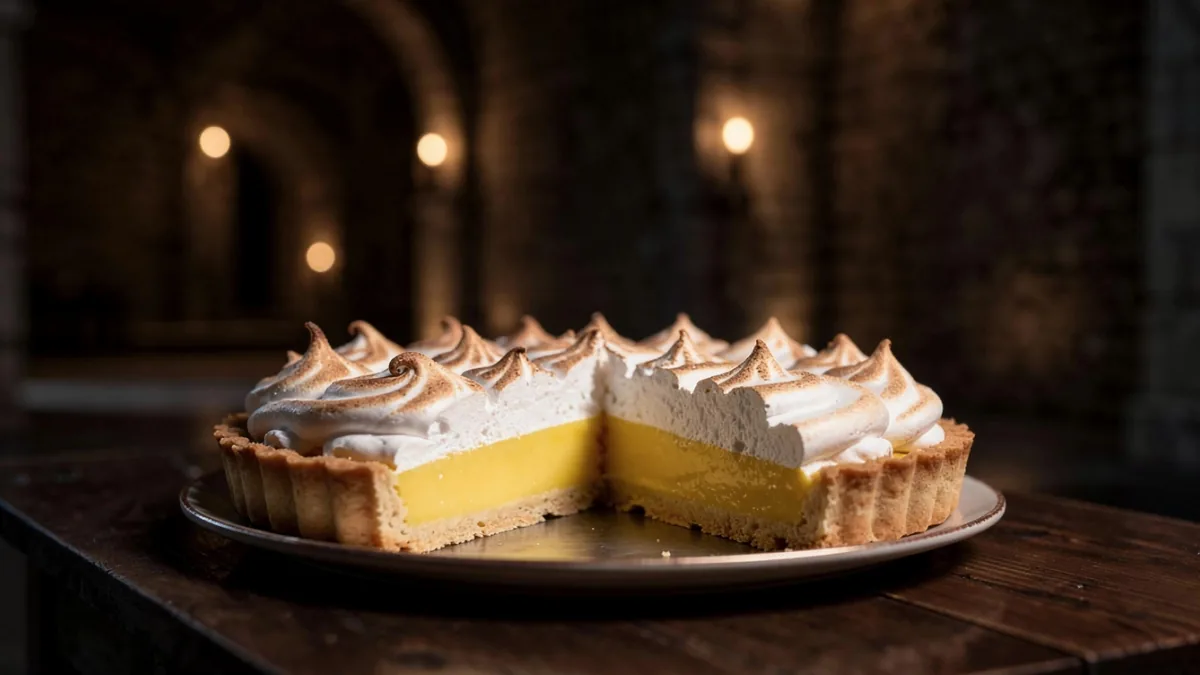
- Briefly reheat the filling and pour it into the baked case. Immediately dollop meringue around the edge and spread it right up to the pastry so it cannot slip, then pile the rest in the middle and swirl lightly.
- Bake in the oven for 18 to 20 minutes, until the meringue is crisp and lightly browned. Leave to stand in the tin for 30 minutes, then unmould and let cool for at least another 30 to 60 minutes. Eat on the day.
Drink with it
Sweet wine · excellent match
Moscato d'Asti or Riesling Auslese, well chilled
The wine has to be sweeter than the meringue: its residual sweetness carries the sugary crown, while its lively acidity stands up to the lemon filling.
Which wine goes with dessert? Comparing sweetness deliberatelyFruit liqueur · excellent match
Limoncello, ice cold and neat in a chilled glass
It mirrors the lemon zest in the filling; the cold takes the heaviness off the sweetness.
Sparkling wine · good match
Crémant or Sekt, demi-sec
Fine bubbles loosen the buttery filling, and the residual sweetness stops the wine tasting sour next to the meringue.
Sparkling wine, Champagne, and Prosecco: what's the difference?Ginjo sake · good match
Ginjo, well chilled (8 to 10 °C)
The floral, citrusy fruit and gentle sweetness of Ginjo go with the lemon filling without overwhelming the meringue.
Junmai, Ginjo, Daiginjo: What do these mean for sake?