The short answer
Junmai means: no brewer's alcohol was added to this sake. Ginjo and Daiginjo say something completely different. They relate to how much the rice was polished before brewing. So the terms answer two different questions, and both can appear together on a single bottle.

The number describes what remains of the rice
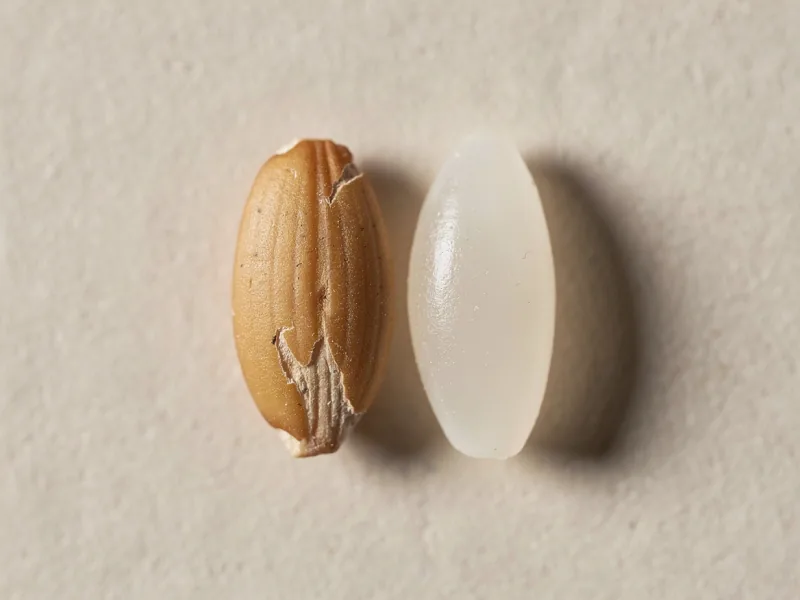
Before brewing, the rice is polished. The outer layers of the grain are ground away until mainly the core remains. How much remains is what the terms Ginjo and Daiginjo describe.
You know the principle from the kitchen. White rice from the supermarket is also polished rice, just nowhere near as heavily processed. With sake, the polishing goes much deeper into the grain.
With Ginjo, at most 60 percent of the original rice grain remains; with Daiginjo, at most 50 percent. What matters is the direction the number counts in: it states what's left, not what's been removed. A polishing ratio of 60 percent doesn't mean 60 percent was removed.
There's a clear reason for polishing. The outer layers of the grain contain protein and fat. These can turn into coarse or harsh notes in the finished sake. The starchy core in the middle produces the cleaner result.
At a 50 percent polishing ratio, half of every grain is ground away. That's a considerable effort. It takes time, technique, and a lot of rice that ultimately doesn't end up in the glass. That's exactly what's reflected in the price.
"Junmai," on the other hand, answers a completely different question. It means no alcohol was added. It has nothing to do with polishing. That's why the terms can be combined: a Junmai Daiginjo is both at once.
More polishing doesn't mean better sake
More polishing is no proof that you'll like the drink better. The terms describe a direction. They're not a scale running from good to better to best.
Heavier polishing tends to produce more delicate, fruitier, and lighter sake. If you like it savory and rice-forward, you'll more likely find what you're after with less polishing. Both can be made cleanly. They're just not the same thing.
With food, the ranking often flips. A bolder Junmai can be the better pairing than an elegant Daiginjo. A very delicately fragrant sake stands little chance of even being noticed next to a spicy dish.
Ask in the shop about the style description and what food the bottle is meant for. These two questions will get you further than any shortcut based on the label's designation.
You'll learn it fastest with a glass in hand. Deliberately compare two small samples by taste, and only then match up the terms. Note whether you pick up fruit, grain, or spice. After a few bottles, you'll know which direction is yours.
With these terms, more expensive mainly means more labor-intensive. Whether you enjoy the effort is a separate matter. Your palate decides, not the label.