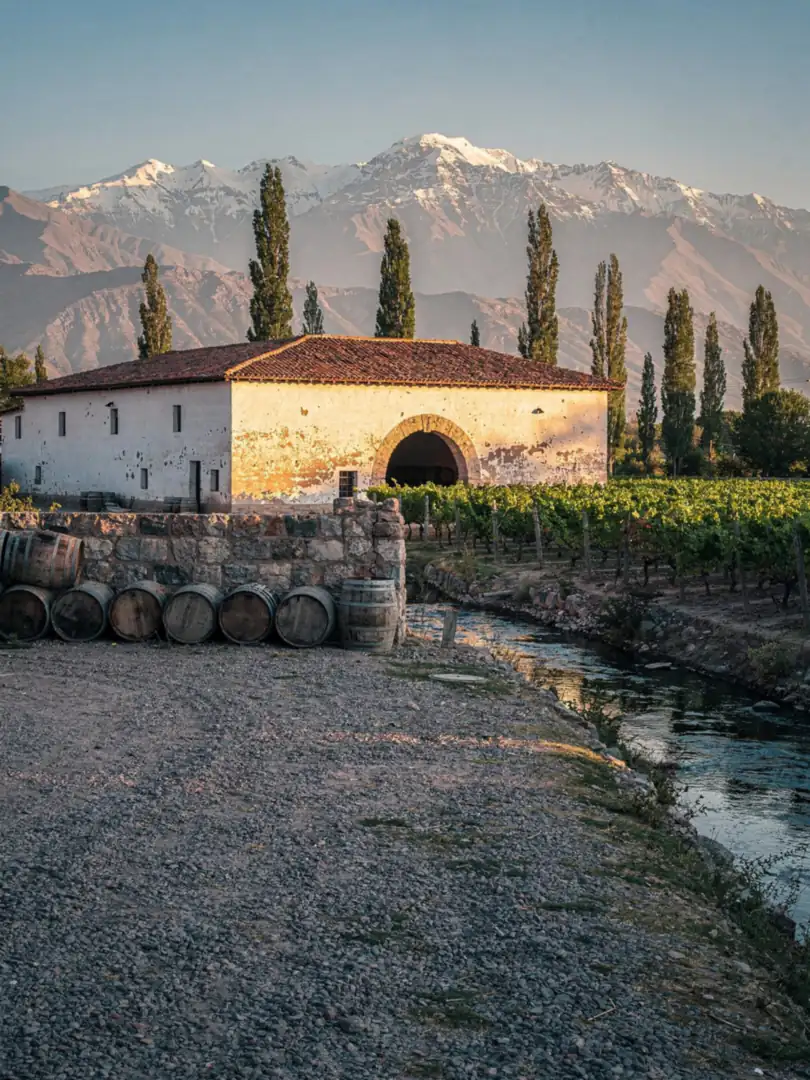
Chandon in Agrelo
Region & History
Sparkling wine in Argentina has a clear birth date, and it's in Mendoza. In the late 1950s, Robert-Jean de Vogüé of Moët & Chandon went looking for a country where bottle fermentation could be built up on a grand scale outside Champagne. Together with the oenologist Renaud Poirier, he traveled through Argentina and ultimately settled on Agrelo.
Agrelo belongs to Luján de Cuyo, south of the city of Mendoza, and sits at the foot of the Andes at nearly 1,000 meters of elevation. According to the house, Moët & Chandon bought a four-hectare plot there in 1959 and founded the estate on September 9, 1960. It's considered the first Moët & Chandon venture outside France. Its Californian sister estate didn't emerge until 1973, a story told under Carneros & Napa.
The choice was no accident. Mendoza is desert land with little rain; the vines live on meltwater from the Andes. In return, the altitude brings cool nights, exactly what a base wine needs if it's later meant to taste lively in the glass. Chandon explicitly cites the wide temperature swings and the mountain water as reasons for the location.
Over the years, cultivation crept higher, into the Valle de Uco and Tupungato. The trade press now places the Baron B line under the Uco appellation.
The Spanish word for sparkling wine is espumante. Argentine wine law groups Vino Espumoso, Espumante, Champaña and Champagne into a single category; the wine institute INV folded them into wine law No. 14,878 via Resolution C 1/03 of January 23, 2003. In Europe, by contrast, the name Champagne is reserved for Champagne itself, so a bottle from Mendoza may not carry that name here.