Keuper and Vaults
Soil & Climate
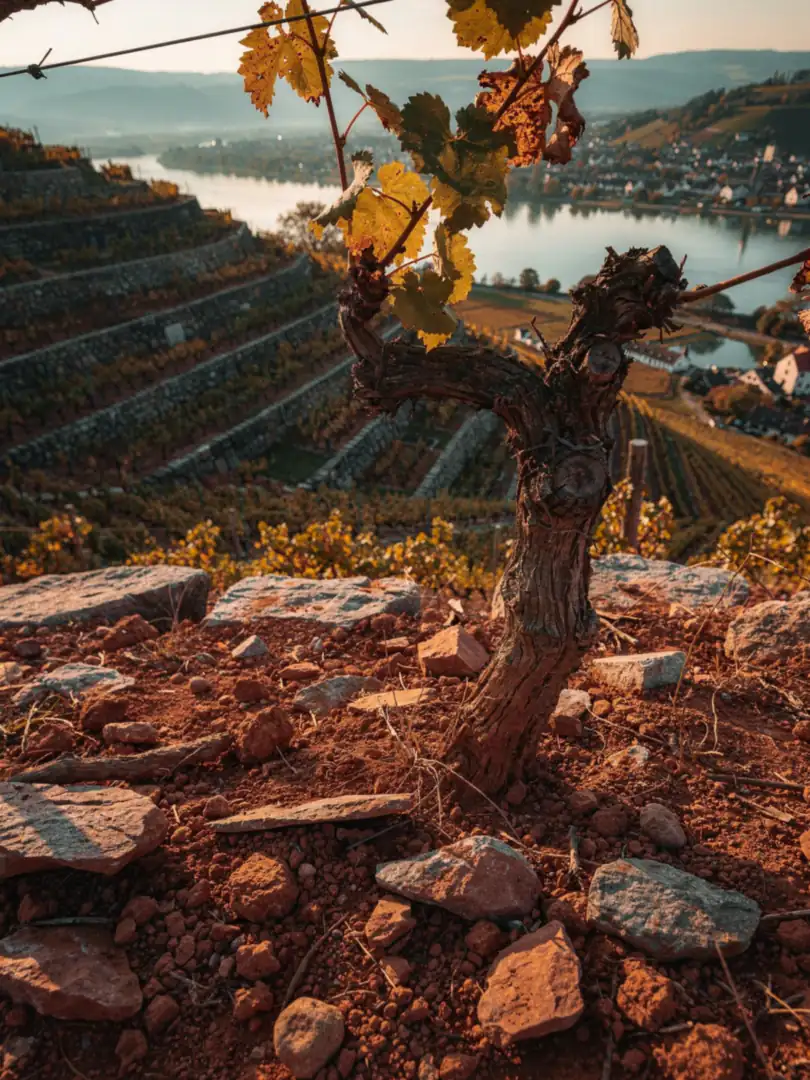
Above the Neckar near Esslingen, the vines grow on Keuper, a rock formation from the Triassic period that appears here as Keuper marl, gypsum keuper and variegated marl. The soils are deep, often reddish in color and rich in minerals. Along the middle Neckar, islands of shell limestone appear in between.
For sparkling wine, what matters most is what the soil leaves behind in the wine, namely acidity. A base wine for the second fermentation should be taut and rather lean, since the dosage can still raise the alcohol by up to 1.5 percent by volume. A broad, heavy still wine would seem clumsy afterward. Riesling ripens late and retains its acidity, which is why it leads among the base wine grapes in Esslingen.
The winegrowers of the region, called Wengerter in Swabian, do much of their work on steep slopes. Where the gradient is at least 30 percent, a Sekt b.A. may carry the designation "Steillage" (steep slope). Anyone who hand-harvests such terraces in autumn understands why hand-picking here is rarely a marketing phrase and mostly just hard work.
With sparkling wine, the cuvée usually matters more than the single vineyard, since differences between slopes even out in the blend. That's why sparkling wine houses in Württemberg more often cite a grape variety and vintage than a specific vineyard.
The second part of the terroir lies beneath the town. In the vaulted cellars of the Speyrer Pfleghof, the temperature barely fluctuates, and a sparkling wine resting on its lees for months matures evenly there. Between the stones, time seems to pass more slowly than it does out on the vineyard slopes.