Bottle, Tank, Cooperative
The Second Fermentation
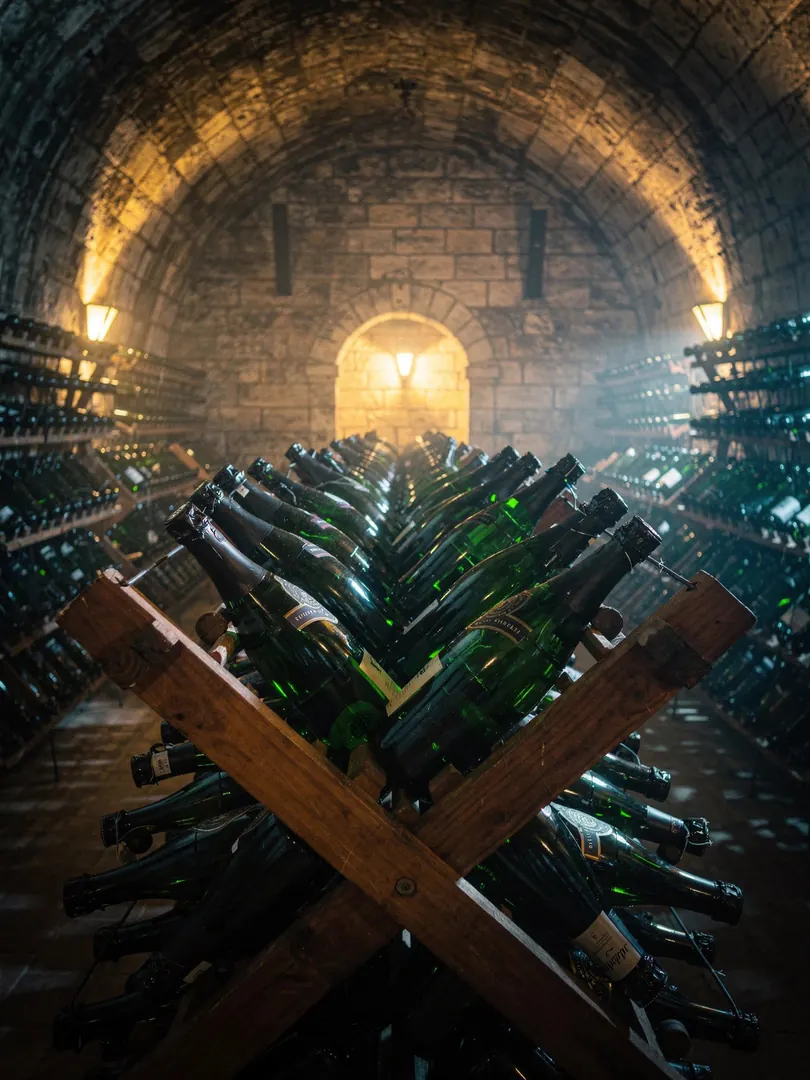
Kessler in Esslingen relies on traditional bottle fermentation. The finished base wine receives a tirage dosage of wine, sugar and yeast, is filled into bottles and sealed with a crown cap. The second fermentation then begins in the bottle, and the carbon dioxide, with nowhere to go, dissolves into the wine.
The sugar turns into alcohol and carbon dioxide. A sparkling wine must afterward reach a pressure of at least 3.5 bar, while Champagne typically sits around 6 bar. The bottles must therefore be especially thick-walled and lie stacked in the cellar until the wine has settled.
Not every "bottle fermentation" is the same. If the label simply says "Flaschengärung" (bottle fermentation), the wine may be decanted after fermentation and filled into a different bottle, known as the transfer method. "Traditional bottle fermentation," on the other hand, requires that the sparkling wine stays in the same bottle, rests on the lees for at least nine months, and is disgorged directly from it.
Most branded sparkling wines are made in tanks. The second fermentation takes place there in a large vessel, and because this happens faster, six months of production time suffice, including at least 90 days of contact with the lees. With agitation in the tank, 30 days is enough. This makes tank-fermented sparkling wine practical for large volumes, without it necessarily being of lower quality.
Cooperatives in the region also work with bottle fermentation. The Fellbacher Weingärtner, for example, fill a Riesling sparkling wine using traditional bottle fermentation. For them, that means making room in the cellar and having patience, since every bottle rests undisturbed for months before it may even be sold.
A Crémant is also possible in Germany, as soon as the sparkling wine is produced as a Sekt b.A. from Württemberg and meets the strict conditions of traditional bottle fermentation. The name then requires hand-harvesting and a sugar content below 50 grams per liter.
Kessler Jägergrün Riesling BrutBottle fermentation · Riesling
- Time on lees
- 9–20 Months
- Sugar
- 0–12 g/l
- Alcohol
- 11–12 % vol
Taut Riesling acidity, citrus and green apple, with a fine note of yeast.