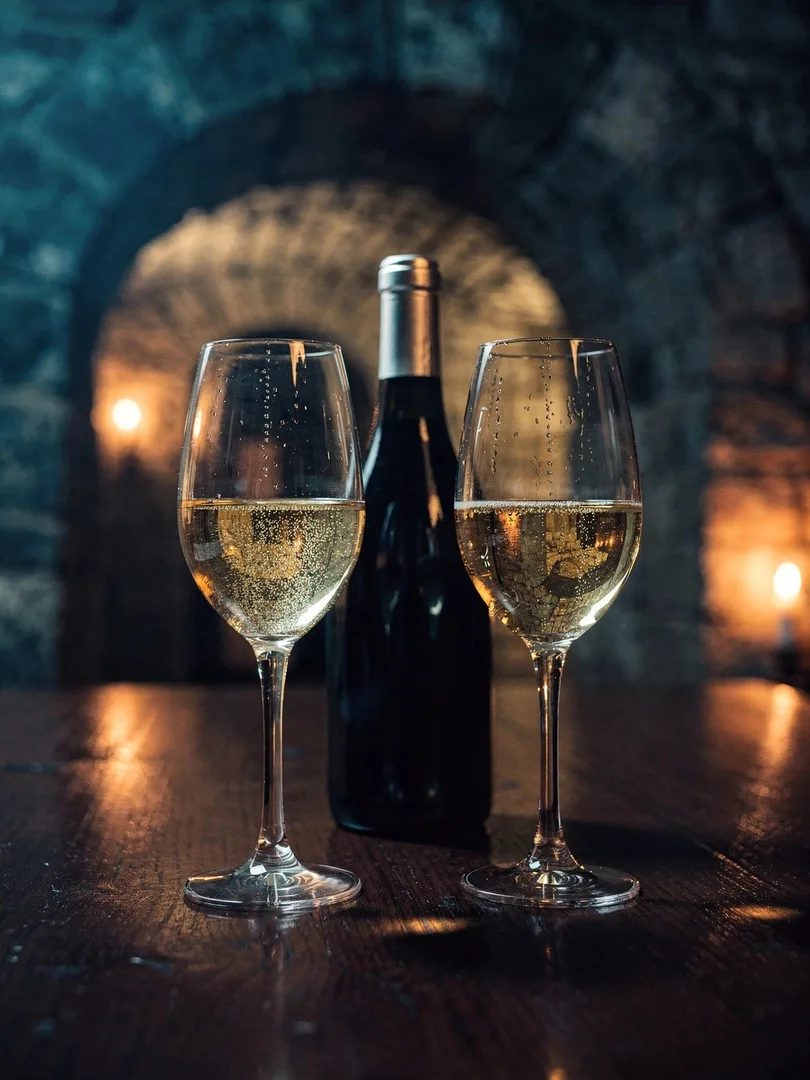
Riesling in the Glass
Tasting
A Riesling sparkling wine from Esslingen smells of lemon, green apple and a touch of pastry, and comes across in the mouth as taut and lean. The bubbles are fine and rise for a long time, with the acidity remaining noticeable through the midpalate. A sparkling wine made from Pinot Noir, by contrast, is rounder, with notes of red fruit and nuts.
A good example is the Kessler Jägergrün Riesling Brut, a bottle-fermented sparkling wine made from Riesling. A second example comes from the Fellbacher Weingärtner, who produce both a Riesling Sekt Brut and a "Next Generation" sparkling wine as Brut Nature. Both show how broad the style range can be in the region, from taut Brut to a completely dosage-free wine.
The glass makes a real difference. A shallow coupe lets the bubbles dissipate quickly and gives the aroma little room. Better is a tulip-shaped glass, which narrows toward the top, concentrates the bubbles and gathers the aromas. It should be filled only about a third full, leaving room to nose the wine, so that every sip gets some air.
Well chilled, sparkling wine tastes best between 6 and 8 degrees Celsius (roughly 43–46°F); warmer, it seems broader, colder, it shuts down the aromas. When opening a bottle, hold it at an angle, keep a firm grip on the cork, and turn the bottle, not the cork. It should give a quiet hiss, not a loud pop. That way, the carbon dioxide stays in the wine and the cork stays in your hand.
Finally, it's worth taking a second sip after a few minutes in the glass. By then, the yeast notes and fruit have opened up, and the sparkling wine reveals just how much time went into it in the cellar. Those who enjoy comparing can try a Brut alongside an Extra Dry and notice that the difference lies purely in the sugar.