Picked Early
Base Wine & Cuvée
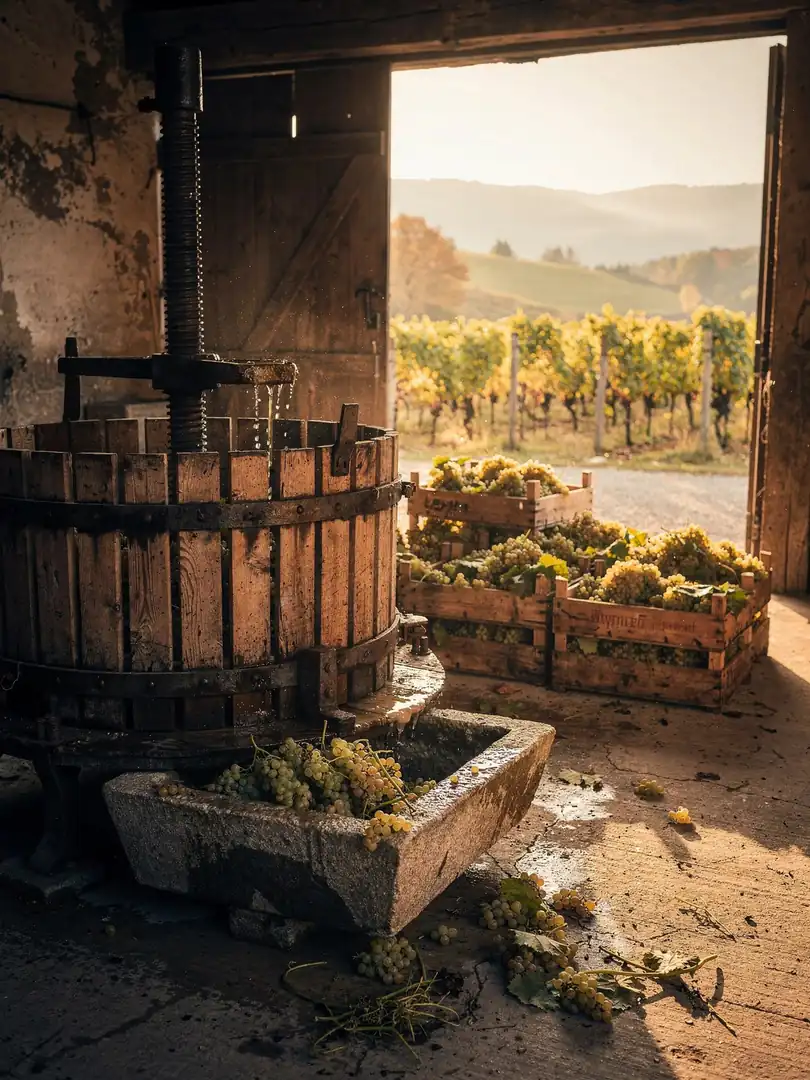
While plenty of grapes still hang in the vineyards along the Pfälzerwald, the presses at Sekt houses along the Deutsche Weinstraße are already running. The base wine destined to become Sekt reaches the cellar earlier than still wine. Fully ripe berries have lower acidity and more sugar—both unfavorable for Sekt.
Under EU law, the base wine must have a minimum total alcohol of 9% ABV. The second fermentation adds a bit more, but by rule no more than 1.5% ABV. If the base wine already carries high alcohol and low acidity, the resulting Sekt turns heavy and broad.
Hand harvesting isn't mandatory for all Sekt, but it is for certain quality tiers. To label a Pfalz Sekt b.A. as Crémant, the grapes must be picked by hand, pressed whole or destemmed, and no more than 100 liters of must may come from 150 kilograms of grapes. Further requirements apply too, such as a maximum sulfur level of 150 milligrams per liter.
How the blend comes together depends on the house. A Winzersekt, say from Deidesheim, must state grape variety and vintage, so its base wine is single-varietal and from one year. The big brands, by contrast, blend lots from multiple sites and varieties so the bottle tastes consistent year after year. That's not a lesser craft—just a different one.
One more distinction is worth knowing. 'Deutscher Sekt' is made from base wines of German origin. If the label simply says 'Sekt,' the base wine may come from other countries too. Anyone wanting Pfalz provenance should therefore look for the designation Sekt b.A. along with the region's name.