Riesling and Pinot
Grape Varieties
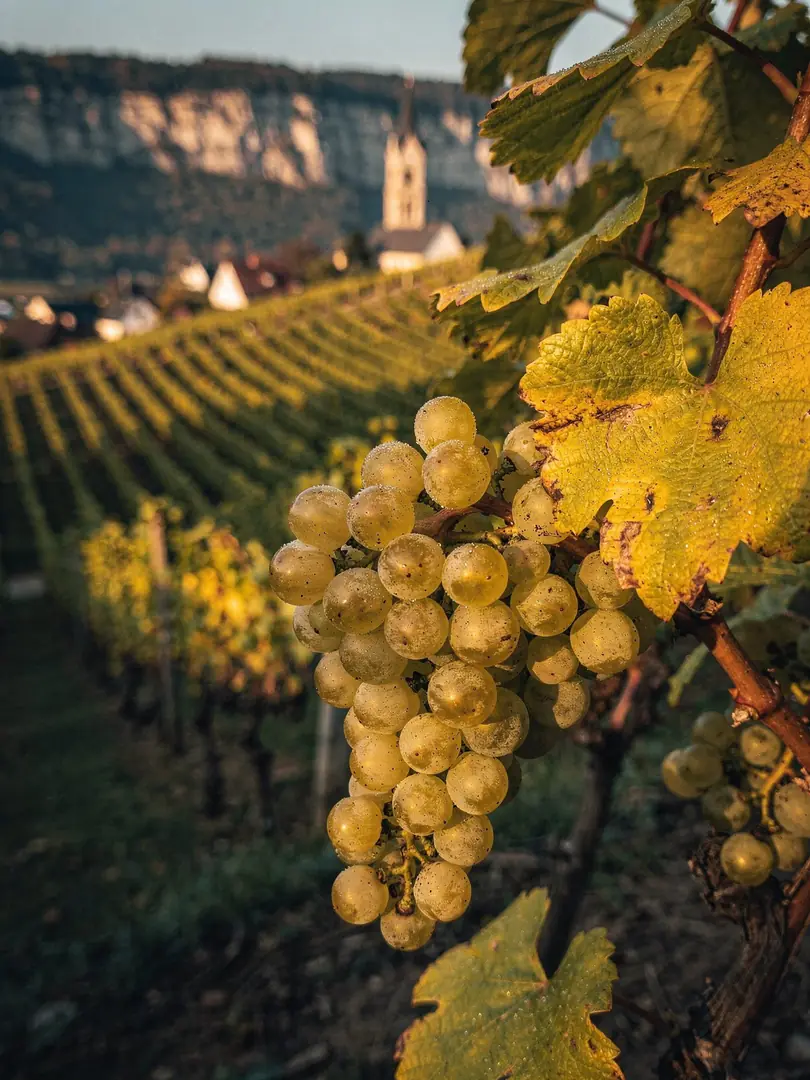
Which grape varieties go into Pfalz Sekt? Mostly Riesling, since at 5,541 hectares it's the most widely planted variety in the Pfalz. Menger-Krug, according to the house, uses only Riesling, Pinot varieties, and Chardonnay for its Sekts. At Schloss Wachenheim, Riesling already appears in the name on some bottles.
Riesling brings high natural acidity and aromas of citrus, green apple, and ripe peach. That's a strong foundation for Sekt, since acidity carries the aging process. On the lees, the fruit slowly develops bready notes, and a young, taut Riesling Sekt grows broader and deeper after a few years.
The Pinot family takes a different path. Pinot blanc (Weißburgunder) yields rounder wines, while Chardonnay adds creaminess. The Weingut von Winning in Deidesheim produces a Sekt called Pinot Brut, made from Pinot blanc. Pinot gris (Grauburgunder) also grows in the Pfalz and appears in some cuvées.
Pinot noir (Spätburgunder) is a red variety, yet its juice is pale. If the berries are pressed immediately, without letting the skins ferment along, the result is a white base wine. Under German sparkling wine regulations, this Sekt may be called Blanc de Noirs if vinified like a white wine. Let the skins macerate briefly, and the result is rosé—as with the Margrit Rosé Brut from Bassermann-Jordan.
Aromatic varieties like Muscat (Muskateller) play a special role. Legally, Sekt made from them counts as an aromatic quality sparkling wine; here, a production period of just one month suffices, and no dosage is added before shipping. That makes it a distinct, sweetly fragrant style alongside dry Riesling.