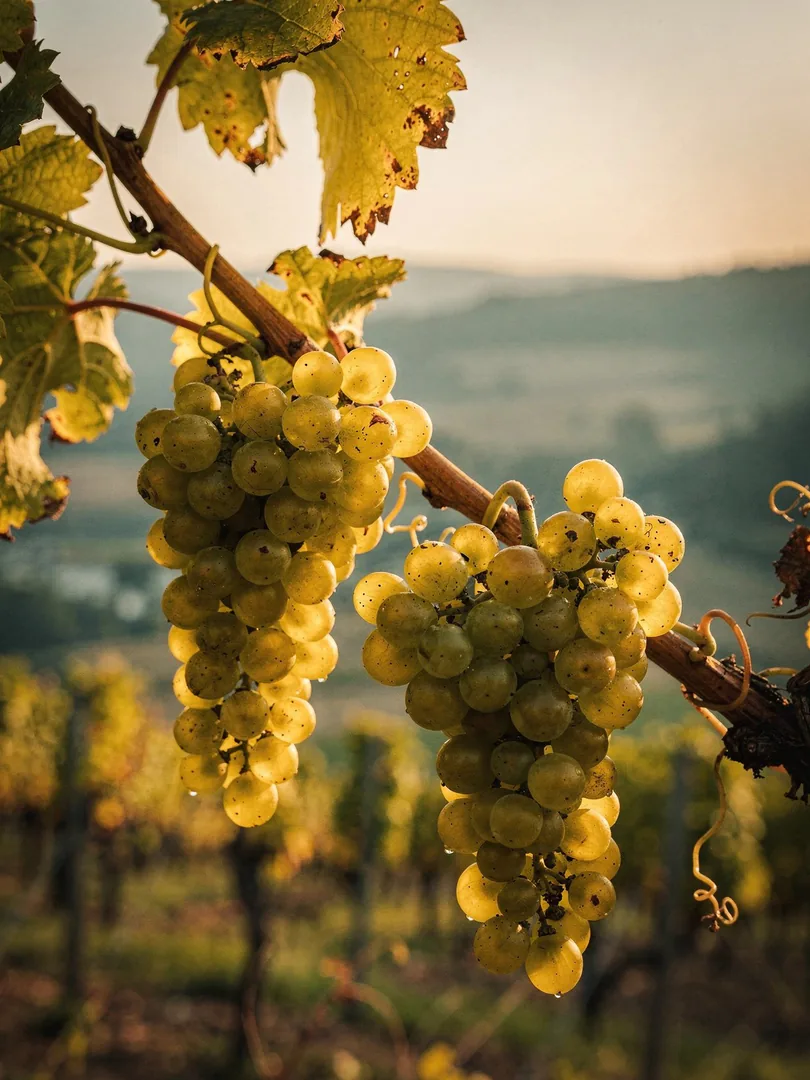
Varieties of the Elbe Slopes
Grape Varieties
Riesling, Goldriesling, Traminer: these are the varieties that set the tone in Radebeul. On the slopes of the Lößnitz, Müller-Thurgau, Spätburgunder, and Scheurebe also ripen. They produce still wines as well as the base wines for Sekt.
Riesling delivers exactly what a Sekt base wine needs: plenty of acidity, little heft, and aromas of citrus and apple. It ripens late and therefore occupies the best hillside sites. In the Elbe Valley, it brings the freshness that a Sekt needs during months on the lees, so that in the end it doesn't taste heavy or broad but stays lean and elegant.
Goldriesling, by contrast, is a crossbred variety. Christian Oberlin created it in 1893 in Colmar, Alsace, with Riesling as one parent. It buds late in spring but can be harvested early, which makes it well suited to cool, marginal sites like the Elbe Valley. It's considered mild and fruity. In meaningful quantities, it's grown almost exclusively in Saxony.
Aromatic varieties have had Sekt successes too: at the 2018 Saxony State Wine Awards, a Scheurebe Sekt from Schloss Wackerbarth and a Traminer Sekt from the Meißen winegrowers' cooperative were honored. Scheurebe brings notes of blackcurrant and grapefruit, while Traminer recalls rose petals and lychee.
Spätburgunder is the region's red variety. When gently pressed so the skins release no color, it yields a white base wine with a hint of cherry and strawberry. It may be sold as Blanc de Noirs if it has the color of a white wine. For Winzersekt, stating the variety on the label is mandatory.