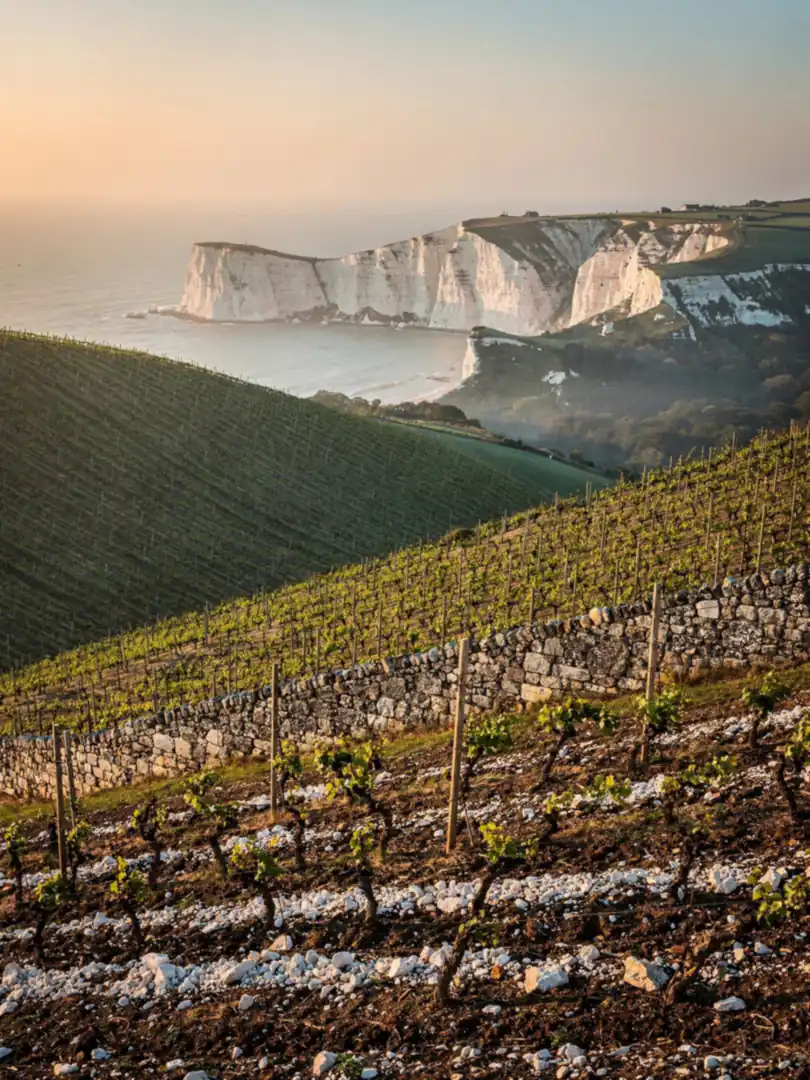
Chalk, Greensand, Clay
Soil & Climate
The South Downs are a chalk ridge running across Sussex, dropping into the sea as white cliffs at the Seven Sisters. Many of the county's vineyards sit on this chalk. Chalk stores water in winter and releases it slowly in summer, so the vines rarely suffer from drought. Anyone with a glass of sparkling wine from Sussex often tastes this chalky freshness.
Rathfinny lies in the Cradle Valley, on a south-facing slope near the Cuckmere Valley and just three miles from the English Channel. According to the winery, the vines there grow on free-draining chalk, across more than 93 hectares. Flints from the vineyards are built into the walls of the buildings.
Further north, the ground changes. Between the Downs and the Weald lie greensand and clay, heavier soils than the free-draining chalk. Ridgeview, near Ditchling, works at the foot of the Downs, where the chalk transitions into these soils. Sussex thus holds several soil types within a small area, and each shapes the wine differently.
The climate is maritime with a continental edge, as Rathfinny itself describes it. This suits sparkling wine well, since the grapes ripen slowly and retain their acidity. This acidity later carries the long lees ageing. Too much heat is rarely the problem in Sussex; spring frost and rain during flowering are more familiar concerns.
The position on the slope matters too. Tillington, a single vineyard owned by Nyetimber in the heart of the South Downs National Park, faces south, is well sheltered and drains quickly. The result is a wine made mostly from Pinot Noir that, according to the house, spends three years on the lees. The comparison with Champagne is hard to avoid: chalk in the soil, a cool climate, acidity as the backbone.