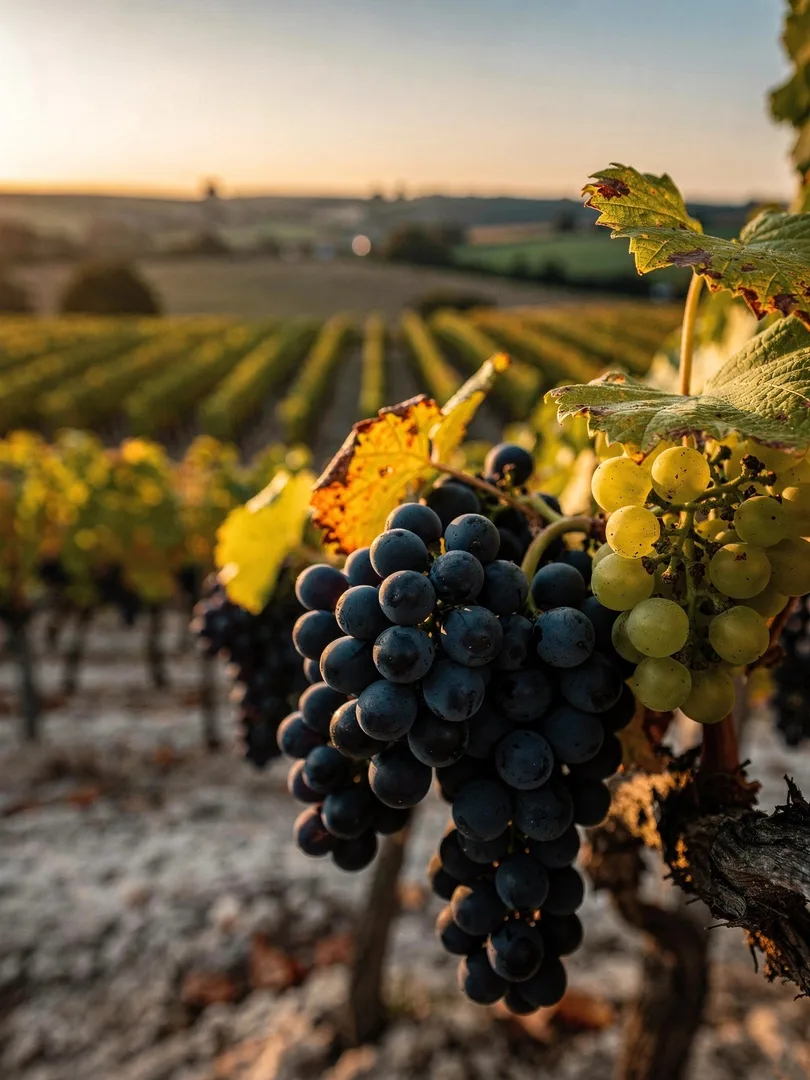
Chardonnay, Pinot, Meunier
Grape Varieties
Chardonnay, Pinot Noir and Pinot Meunier carry the sparkling wine of Sussex, just as in Champagne. Under the PDO rules, they make up the bulk of the blend. Varieties such as Pinot Blanc and Pinot Gris are also permitted, but the three familiar ones almost always dominate in the glass.
Each brings something different. Chardonnay delivers freshness, citrus and the fine minerality of the chalk. Pinot Noir gives body and red fruit, Meunier juiciness and a fruitiness the wine shows early on. Shifting the proportions changes the character: more Chardonnay makes for something lean and citrusy, more Pinot Noir something broader and more powerful.
If only one variety appears on the label, at least 90 percent of the wine must come from it. A Blanc de Blancs is made from white grapes, usually Chardonnay, a Blanc de Noirs from dark grapes, namely Pinot Noir and Meunier, pressed off their skins to produce a white wine. The label thus already hints at the taste.
Houses set different priorities. Rathfinny plants mainly Pinot Noir, Chardonnay and Pinot Meunier on a south-facing slope and bottles four wines: Classic Cuvée, Blanc de Blancs, Blanc de Noirs and Rosé. At Nyetimber, Tillington is predominantly Pinot Noir with a little Chardonnay, while the Blanc de Blancs, as the name suggests, puts Chardonnay centre stage.
Why these varieties in particular? They ripen early enough to reach decent maturity in cool England before the autumn rains, while retaining plenty of acidity. Hybrid vines such as Seyval Blanc are excluded from PDO sparkling wine from England. Bacchus, a German crossing, also grows in Sussex, but mostly for still wine.