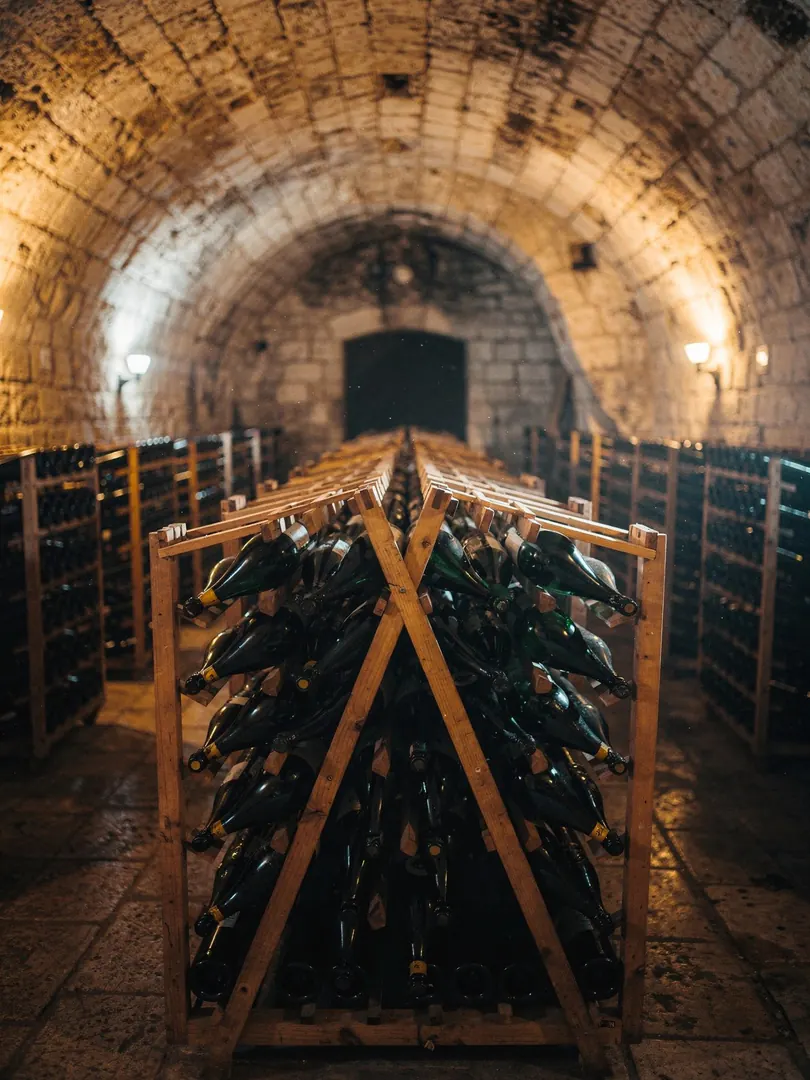
Bottle fermentation only
The Second Fermentation
With Crémant de Bourgogne, only one path leads to the bubbles, and that's fermentation in the bottle. The specifications require that the sparkle form exclusively inside glass bottles. Tank fermentation and transfer methods are not an option for this name, and that is exactly what sets Crémant apart from many simple tank-fermented sparkling wines.
In Rully as in Saint-Bris-le-Vineux, everything begins with the tirage, the bottling of the finished base wine. Sugar and yeast are added to the wine, then the bottle is sealed with a crown cap. The earliest permitted date is December 1 following the harvest; until then, the base wine rests in tank and clarifies.
Inside the sealed bottle, the yeast sets to work on the sugar. This produces a little extra alcohol, but above all carbon dioxide, which has nowhere to escape. It dissolves into the wine until the bottle is under pressure: the specifications require at least 4 bar at 20 degrees, more than double the pressure in a car tire.
Sulfur is also capped. After the tirage, the wine may contain no more than 150 milligrams per liter in total, compared with just 100 in the base wine beforehand. Crémant is also sold in the very same bottle in which the sparkle developed. The only exceptions are very small bottles up to 37.5 centiliters and bottles over 150 centiliters.
The bottles then rest in a dedicated, temperature-controlled space, whether in the quarries of Bailly-Lapierre or in cellars across the Châtillonnais, often stacked on laths, lying horizontally so the yeast settles along the bottle's length. What happens in the glass during this time is the subject of the next stage: how yeast turns into flavor, and how it eventually leaves the bottle again.
Crémant de Bourgogne BrutBottle fermentation · Chardonnay, Pinot noir, Aligoté
- Time on lees
- 9–18 Months
- Sugar
- 6–12 g/l
- Alcohol
- 12–12.5 % vol
Apple, citrus and brioche, crisp acidity, fine bubbles.