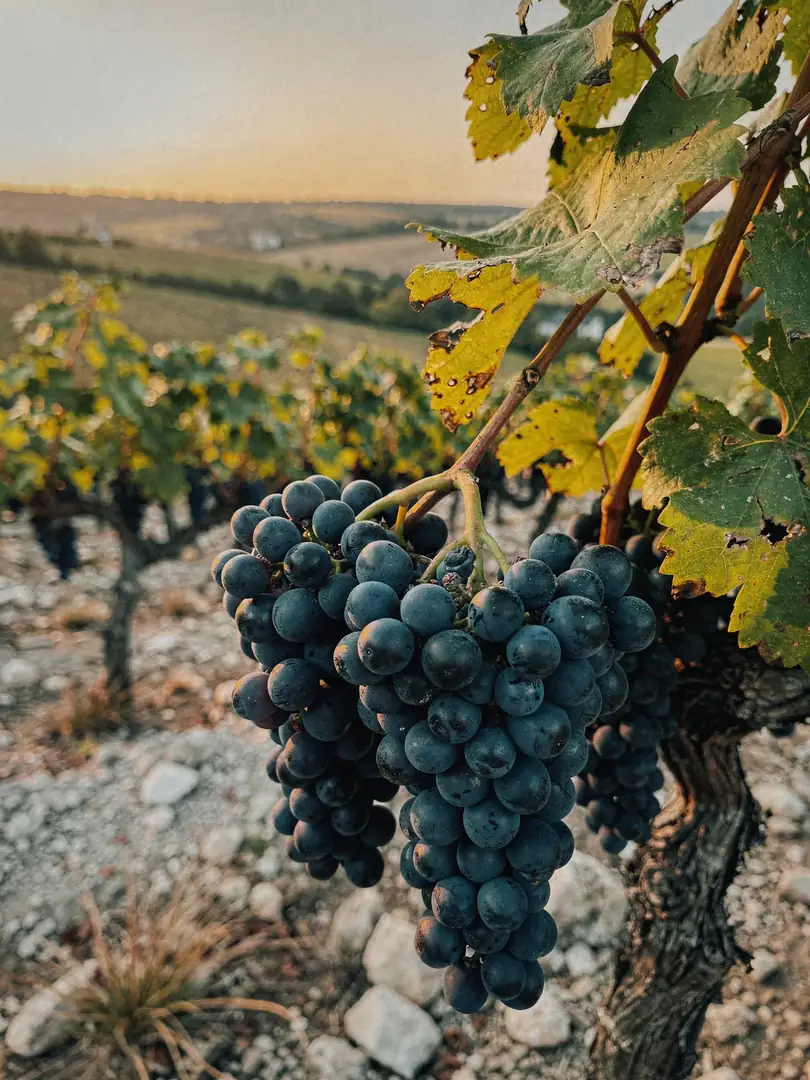
Pinot Noir dominates
Grape Varieties
Nearly four out of five vines in the Côte des Bar are Pinot Noir: 83.9 percent of the planted area. Chardonnay follows at 11.6 percent, Meunier at 3.2 percent. A single variety shapes this region far more strongly than it does the Côte des Blancs, where Chardonnay reigns.
The two sub-areas differ. In the Barséquanais, the Pinot Noir share sits at 85.8 percent; in the Bar-sur-Aubois, 79.6 percent. There, you'll also find more Chardonnay at 13.0 percent and more Meunier at 6.7 percent.
Pinot Noir delivers body, red fruit, and structure. Its color sits in the skin while the juice stays pale. Pressed gently, the must stays white, and red grapes yield a Blanc de Noirs. This is exactly why the variety forms the foundation of winemaking in the Aube.
Champagne permits eight principal varieties plus the adaptation variety Voltis. On Fleury's roughly 15 hectares in Courteron, Pinot Noir grows alongside Meunier, Chardonnay, Pinot Blanc, and Pinot Gris.
Drappier farms, by its own account, 62 hectares near Bar-sur-Aube, about 70 percent planted with Pinot Noir, and has been organic-certified since 2023. Even large producers here bet heavily on the dark grape.
In Les Riceys, Pinot Noir leads a second life. Here it produces the Rosé des Riceys, a still rosé from the three hamlets of Ricey-Haut, Ricey-Haute-Rive, and Ricey-Bas, made after three to five days of skin contact. It has nothing to do with sparkling wine, stands as its own appellation, and belongs on this journey only as a curiosity.