Village by Village
Base Wine & Blend
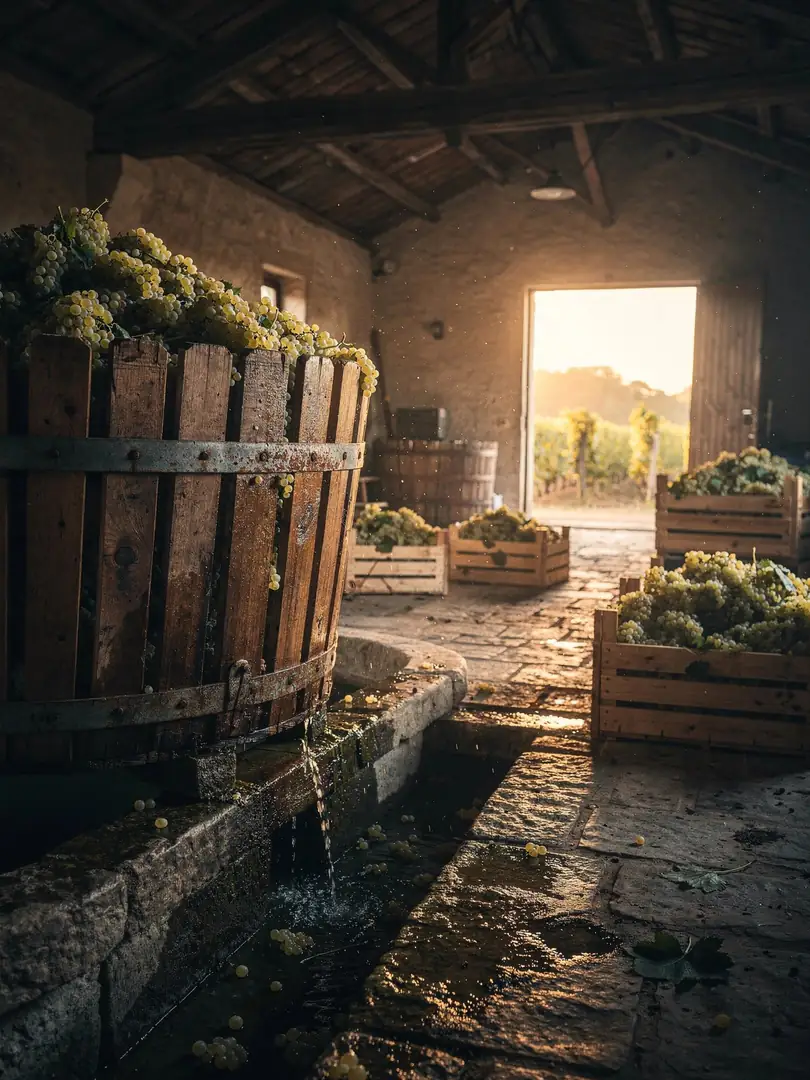
Picking time is determined by acidity rather than sugar, since the base wine needs to stay fresh and avoid becoming heavy. The grapes are hand-picked, as required by Champagne's appellation rules, and go whole into the press.
From 4,000 kilograms of grapes, a single pressing load, no more than 2,550 liters of must may run off. The first 2,050 liters are called the cuvée, the following 500 liters the taille. About 1.2 kilograms of grapes go into a single bottle of Champagne.
The first fermentation produces a still base wine that, tasted alone, is often sharp and acidic. Only the blend, the assemblage, shapes the style. For a non-vintage Blanc de Blancs, cellar masters blend wines from several villages and years, adding reserve wines from older harvests so the house tastes the same every year.
With vintage Champagne, it works differently. All the grapes come from a single year, and a producer may bottle no more than 80 percent of its annual volume as vintage wine, so that reserves remain. Salon makes vintage the rule: the house bottles only Blanc de Blancs, and only in years it considers exceptional. There is no non-vintage Salon.
The Clos du Mesnil pushes the idea furthest: one plot, one year, one grape variety. The Champagne shows vintage and terroir at once, with no other villages to balance it out.
The Blanc de Blancs label simply states that no red grapes were involved. In the Côte des Blancs, that almost always means pure Chardonnay.