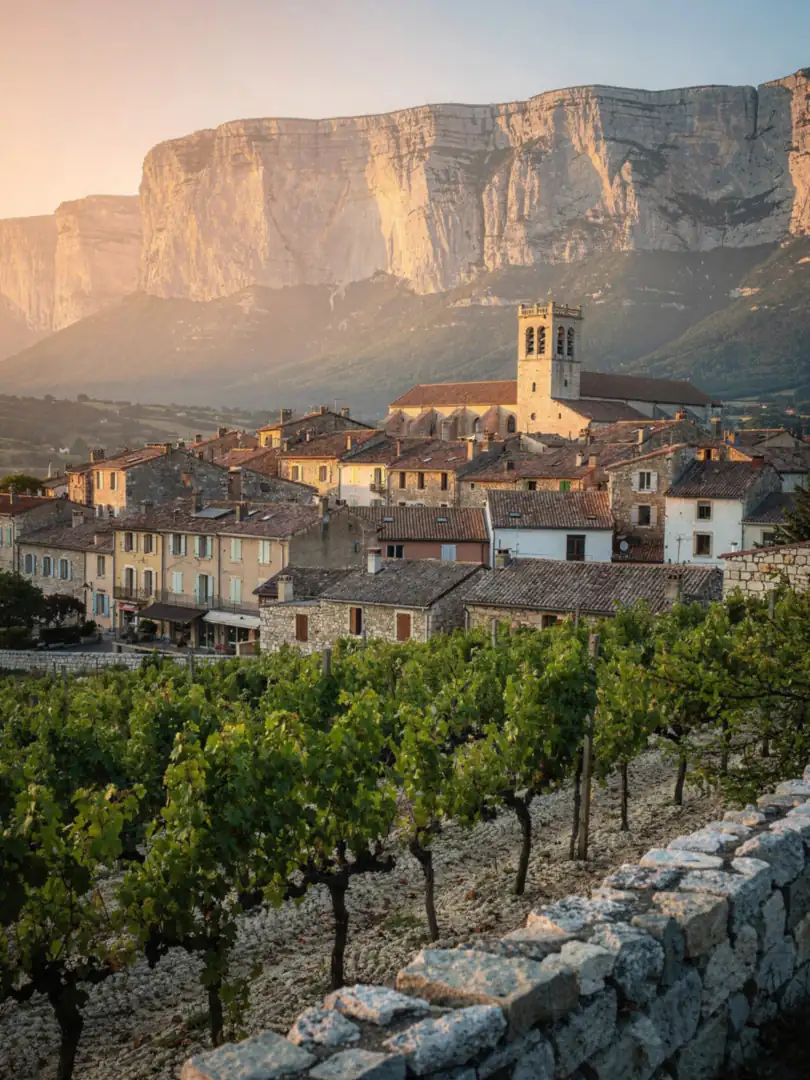
Valley of the Drôme
Region & History
Southeast of Valence, the Drôme valley rises toward the small town of Die, overshadowed by the limestone walls of the Vercors. This is where Clairette de Die is made, a sweet, light sparkling wine often containing just seven to nine percent alcohol. In the valley, people like to trace its history back a long way: the Vocontii, a Gallic tribe, are said to have made a wine here that sparkled on its own, and Pliny the Elder is said to have described something similar. This counts as tradition, not proof.
The name becomes officially documented in the 20th century. A decree from April 21, 1910 recognized Clairette de Die as a designation of origin, followed on December 30, 1942 by the controlled designation of origin, known as AOC. Since then, a strict set of regulations has bound every producer to specific grape varieties, yields, and methods. It was confirmed by decree in 2011 and amended in 2013.
Grapes must be harvested, fermented, and bottled within 31 communes of the Drôme département, stretching from Aouste-sur-Sye in the west up to Châtillon-en-Diois. This landscape is known as the Diois. According to the wine association, around 260 winegrowers work these slopes.
The backbone of the valley is the cooperative Cave de Die, now known as Jaillance. Winegrowers founded it around 1950, and it is considered the most important producer in the Diois. Alongside it, family estates bottle their own wines. The appellation also covers Crémant de Die, a classically bottle-fermented sparkling wine, and still wines labeled Coteaux de Die and Châtillon-en-Diois.
For everything that follows, it's worth remembering: two different sparkling wines go by the name Clairette de Die. The famous sweet version carries the additional designation "méthode ancestrale" and is made mostly from Muscat. The dry version is made purely from Clairette and undergoes a second fermentation in the bottle, just like a Crémant. The sections below focus mainly on the sweet style, since that's what has made the valley famous.