Altitude, Limestone, Cold
Soil & Climate
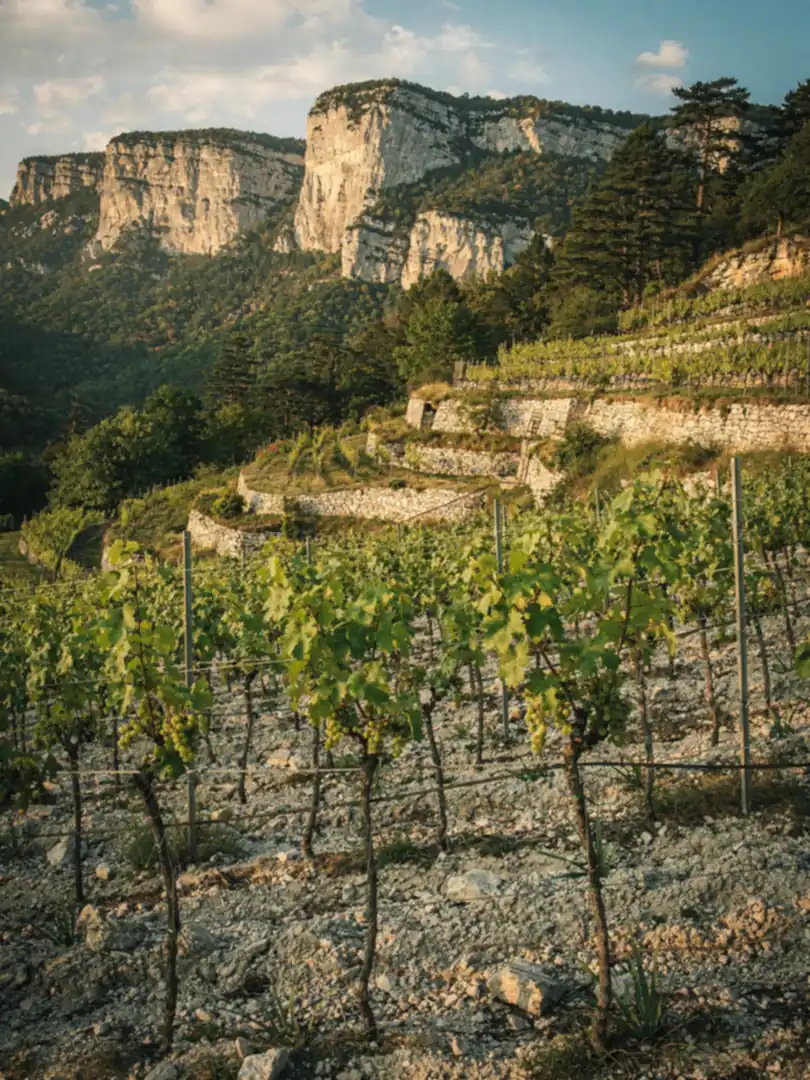
The vines of Clairette de Die don't grow in the lowlands: anyone driving up the Drôme valley from Valence can feel the land rising. The town of Die itself sits at around 450 meters. According to the association, the vines climb as high as about 700 meters, averaging around 550. The landscape feels more alpine than typically southern French. Behind the town rises the pale rock face of the Glandasse, a spur of the Vercors, and beyond it begins the high plateau.
The soil consists of calcareous sandstone, marl, and gravel terraces along the Drôme, often mixed with clay. Clay and limestone retain rainwater, supplying the vines even during dry summers. The climate is temperate with a faint Mediterranean influence, cooled by the altitude and the proximity of the Vercors.
For sparkling wine, cool nights matter most. Where evenings turn chilly quickly, Muscat grapes ripen slowly and retain their aromatic character. Still, they need to reach proper ripeness: the regulations require at least 144 grams of sugar per liter of must and a natural alcohol content of at least 9 percent.
Yields stay low. The base yield is 60 hectoliters per hectare, with 70 as the upper limit, and harvesting is done by hand. The rows are planted close together, with each vine allotted no more than 2.20 square meters, and pruning limited to twelve buds. The exact plot boundaries were set by the INAO institute in 1985 and adjusted several times through 2013.
This wine doesn't need a chalk cellar like Champagne—it needs cold. Because the must must be chilled and filtered in the tank, the regulations explicitly require equipment capable of both filtration and refrigeration for the sweet style. Without it, the method simply wouldn't exist; here, the cooling system plays the role that a rock-cut cellar plays elsewhere.