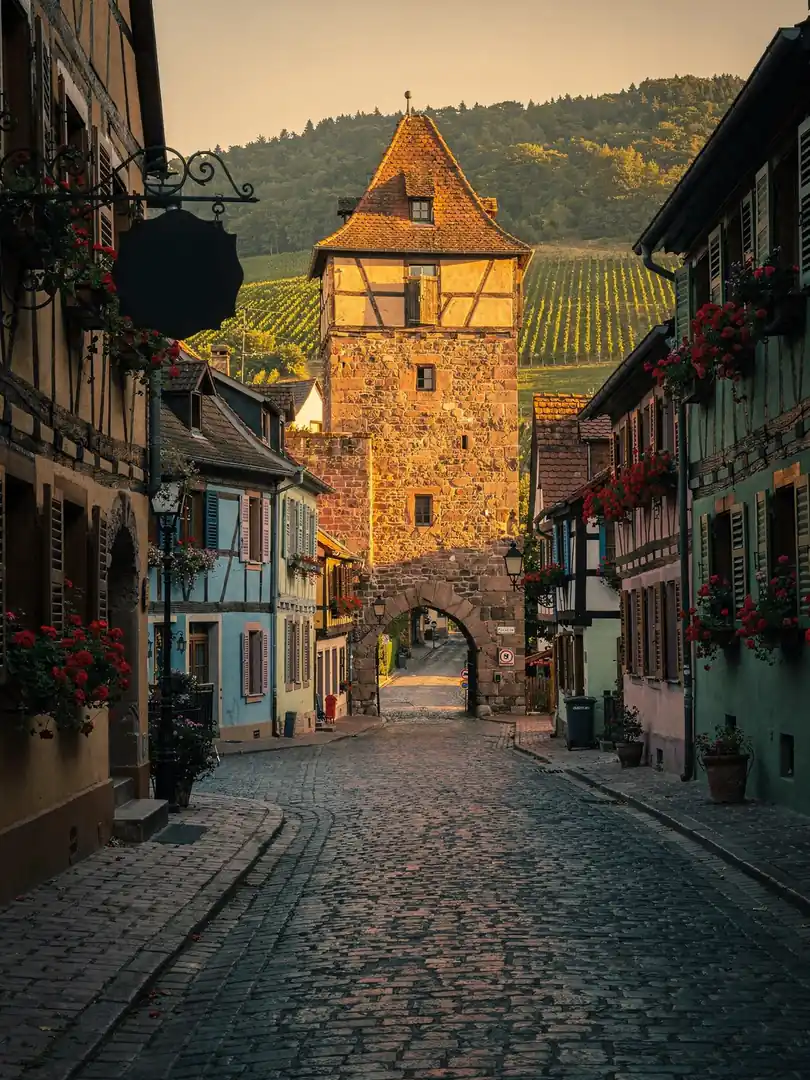
From Riquewihr
Region & History
What is Crémant d'Alsace, and how did it come to Alsace? It's the region's sparkling wine, given a second fermentation in the bottle, just like Champagne, yet carrying its own name. Its story begins around 1900. At the time, Alsace was part of the German Empire. According to the Dopff au Moulin estate, Julien Dopff of Riquewihr saw sparkling wines at the Paris World's Fair that he couldn't stop thinking about.
Afterward, the estate says, he spent two years training at the Champagne house Mercier and brought the method back to his village. The resulting sparkling wine took a long time to become a mass-market drink. By 1979, according to common accounts, only around one million bottles of Crémant were sold.
Then sales took off, and today more than 30 million bottles are produced each year. The framework was set in 1976 with the wine's own appellation, its protected designation of origin. It requires hand-harvesting, a maximum of 100 liters of must from 150 kilograms of grapes, and bottle fermentation, and the name Crémant may only appear together with "d'Alsace."
Anyone looking for the difference between Crémant and Champagne will find it first in timing and grape varieties. Non-vintage Champagne must age at least 15 months from bottling, while EU regulations require at least nine months on the lees for Crémant. In Alsace, meanwhile, Pinot blanc takes center stage instead of Chardonnay.
The industry rests on family houses like Dopff au Moulin as well as cooperatives. The Wolfberger cooperative in Eguisheim, near Colmar, founded in 1902, is considered the region's largest Crémant producer. Around 450 winegrowers belong to it, and many of the bottles found on store shelves as a matter of course come from its cellars.