Six Bars of Pressure
The Second Fermentation
Usually in spring following the harvest, the finished blend is bottled, and that's where the bubbles are born. By law, bottling may begin no earlier than January 1st after the harvest. Sugar and yeast are added, together known as the liqueur de tirage, at a benchmark of roughly 24 grams of sugar per liter.
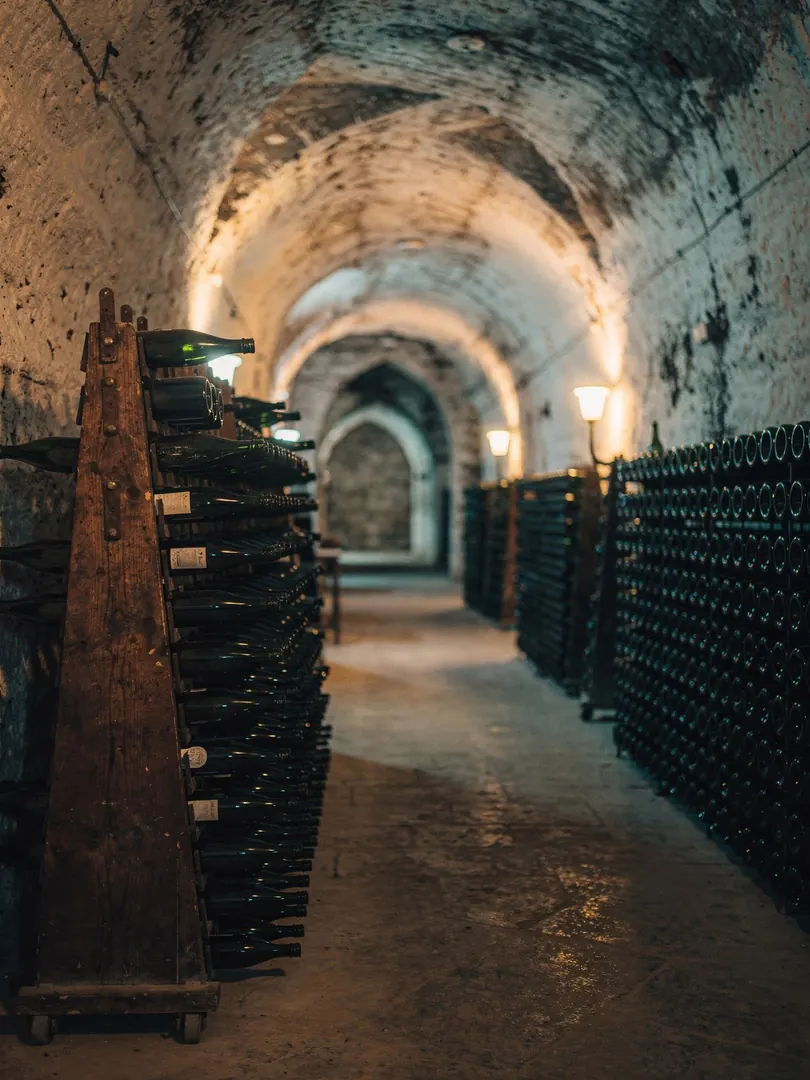
The bottle is sealed with a crown cap, similar to a beer bottle, and then laid horizontally in the cellar. The yeast consumes the sugar, producing a bit of alcohol and carbon dioxide. Since the gas can't escape, it dissolves into the wine. The tirage dosage may raise the alcohol content by no more than 1.5% ABV. In the end, the bottle holds a pressure of around six bars, more than double that of a car tire.
Champagne is only allowed to ferment in the very bottle in which it will later be sold. The appellation's rules mandate that the second fermentation take place exclusively in glass bottles. Transferring the wine under pressure, known as transvasage, is only permitted for small bottles under 37.5 centiliters and for large formats over 1.5 liters. Tank fermentation, common for many branded sparkling wines and for Prosecco, has no place in Champagne production.
For the houses along the Avenue de Champagne, this means the bottle resting in the cellars of Moët or Pol Roger is the very same bottle that later arrives in your glass. It isn't transferred for years, only turned. How this method compares to Sekt and Prosecco is explained in the article on bottle fermentation.
Champagne Brut, non-vintageBottle fermentation · Chardonnay, Pinot Noir, Meunier
- Time on lees
- 15–36 Months
- Sugar
- 6–12 g/l
- Alcohol
- 12–12.5 % vol
Reserve wines maintain the house style: apple, citrus, brioche, taut acidity.